Government Probes Formaldehyde-Treated Cabbages in Hebei; Tracing Distribution Routes
SingTao · 2 SOURCESabout 1 hour ago2 MIN
Summary
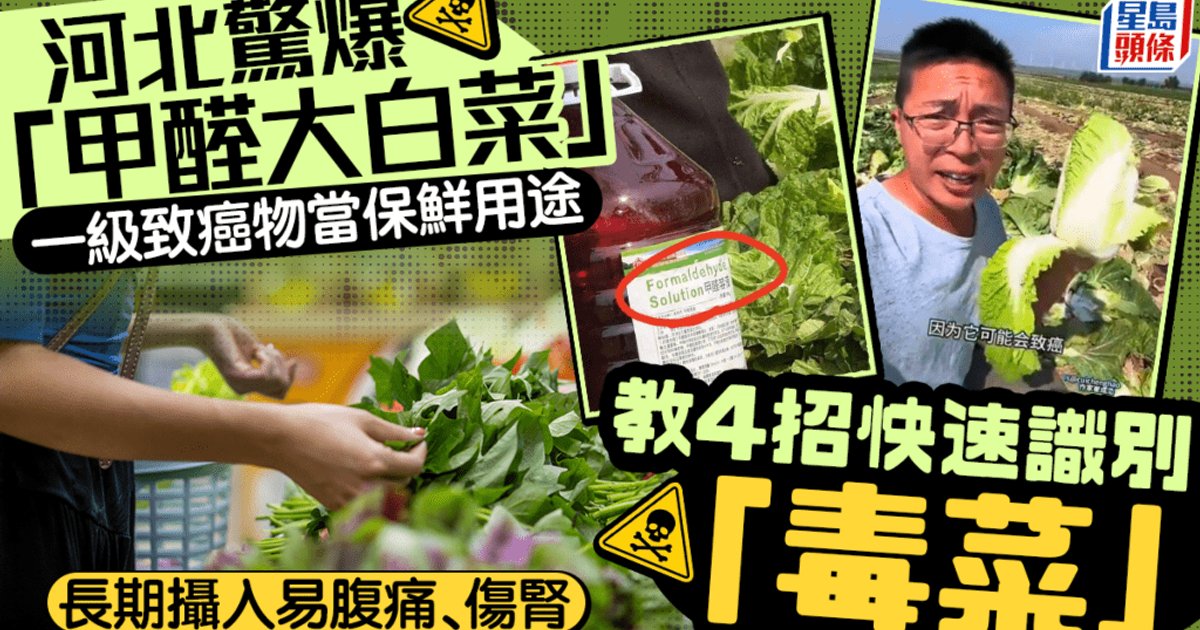
China's top food safety authorities are investigating reports that cabbage traders in Kangbao County, Hebei Province, were dipping vegetables in a cancer-causing formaldehyde solution for preservation during long-distance transport. A social media blogger documented that vendors at Tunken Township were coating cabbage roots with the toxic chemical before shipping. The contaminated produce was destined for Suqian City in Jiangsu Province. Local authorities have seized the affected cabbages and taken compulsory measures against suspects while tracing distribution channels nationwide.
Key Points
- Environmental blogger "Yuli Qi Ge" filmed vendors at Tunken Township, Kangbao County, Zhangjiakou, Hebei Province dipping cabbage roots in formaldehyde solution before long-haul loading
- The treated cabbages were destined for the China Agricultural Products Suqian Modern Agricultural Logistics Park in Jiangsu Province
- Formaldehyde, classified as a Group 1 carcinogen by the International Agency for Research on Cancer, can cause severe abdominal pain, vomiting, kidney damage, coma, or death if ingested in large quantities
- The State Council Food Safety Office, Ministry of Agriculture, and State Administration for Market Regulation are guiding the investigation and ordered immediate nationwide inspections of perishable vegetables
- Kangbao County authorities confirmed the reports, with police taking compulsory measures against relevant personnel and vehicles while conducting emergency traceability checks
Why It Matters
This incident exposes a dangerous food safety loophole where carcinogenic chemicals are being used to extend the shelf life of vegetables entering the supply chain, potentially affecting consumers across multiple provinces. The involvement of top-level government bodies signals a zero-tolerance approach to food adulteration, but the case also highlights how easily contaminated produce can reach markets without proper detection. For Hong Kong consumers who frequently purchase vegetables from mainland suppliers, this case underscores the importance of food testing and traceability systems to prevent unsafe produce from entering the local market.
This incident exposes a dangerous food safety loophole where carcinogenic chemicals are being used to extend the shelf life of vegetables entering the supply chain, potentially affecting consumers across multiple provinces. The involvement of top-level government bodies signals a zero-tolerance approach to food adulteration, but the case also highlights how easily contaminated produce can reach markets without proper detection. For Hong Kong consumers who frequently purchase vegetables from mainland suppliers, this case underscores the importance of food testing and traceability systems to prevent unsafe produce from entering the local market.