How to Choose Lactose-Free Milk or Plant Milk
AM730 · 1 SOURCESabout 8 hours ago6 MIN
Summary
People who develop bloating or diarrhoea after drinking milk are increasingly turning to lactose-free milk or plant-based alternatives, but the two are not nutritionally interchangeable. Lactose-free milk is made by breaking lactose into simpler sugars rather than removing sugar entirely, while plant milks vary widely in protein and calcium content. The report says consumers should first distinguish between lactose intolerance, cow’s milk allergy and vegan dietary choice before deciding what to buy. It also urges label checks on protein, calcium and total sugar.
Key Points
- The report distinguishes three reasons for avoiding milk: lactose intolerance, cow’s milk allergy and veganism, each requiring different dietary restrictions and product choices.
- Lactose intolerance is described as a digestive issue caused by low lactase in the small intestine, with symptoms including diarrhoea, nausea, vomiting, cramps, bloating and gas.
- Cow’s milk allergy is an immune reaction to milk proteins such as casein and whey; lactose-free milk still contains these proteins and is unsuitable.
- Endocrinologist Tsai Ming-chieh (蔡明劼) said lactose-free milk is produced by enzymatically splitting lactose into glucose and galactose, which may be absorbed faster.
- In Tsai’s continuous glucose monitoring test, one cup of lactose-free fresh milk raised blood glucose from 93 mg/dL to 176 mg/dL in under an hour.
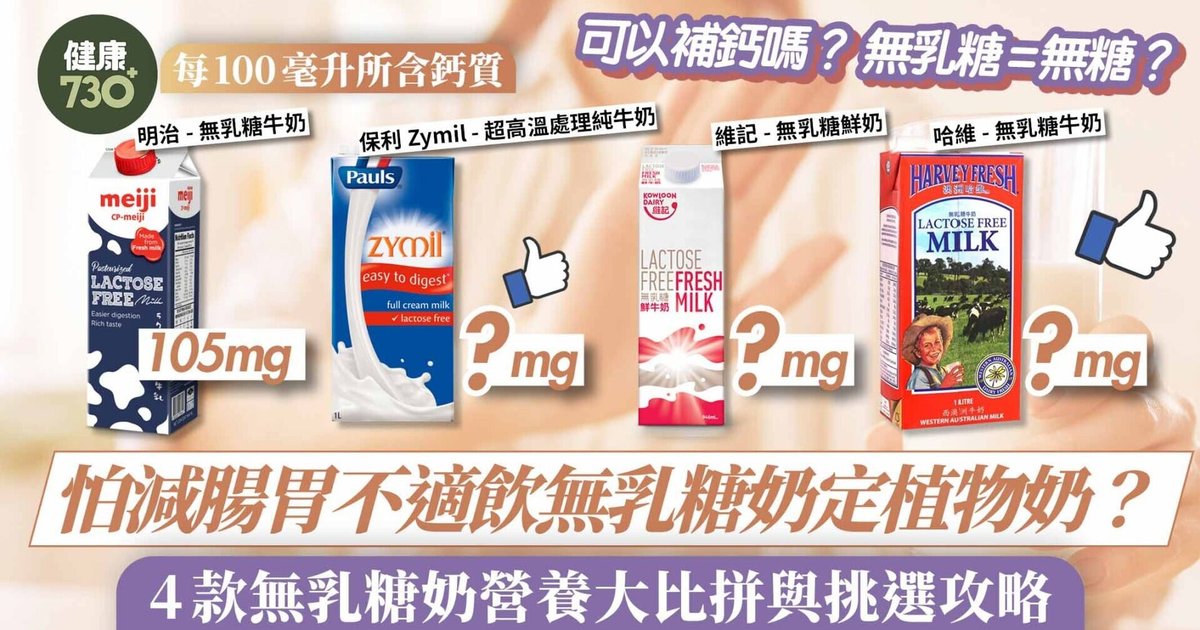
- Among four products cited, Meiji’s lactose-free milk drink provides 64 kcal, 3.2 grams of protein, 105 mg calcium and 2.5 grams of sugar per 100 ml.
- Kowloon Dairy’s lactose-free fresh milk provides 65 kcal, 3.1 grams of protein, 44 mg calcium, 4.6 grams of sugar and 3.8 grams of fat per 100 ml.
- Harvey Fresh lactose-free milk provides 69 kcal, 3.4 grams of protein, 110 mg calcium, 4.6 grams of sugar and 3.5 grams of fat per 100 ml.
- Zymil UHT pure milk provides 65 kcal, 3.3 grams of protein, 120 mg calcium, 4.7 grams of sugar and 3.6 grams of fat per 100 ml.
- Citing Hong Kong’s Centre for Food Safety, the report says only products with 120 mg of calcium per 100 ml qualify as “high calcium”.
Why It Matters
For Hong Kong consumers, the story is a reminder that “lactose-free” does not mean sugar-free, and that digestive comfort does not automatically equal better blood sugar control. It also shows that plant milk may not replace dairy nutritionally unless buyers actively compare labels for protein, calcium and added sugar.