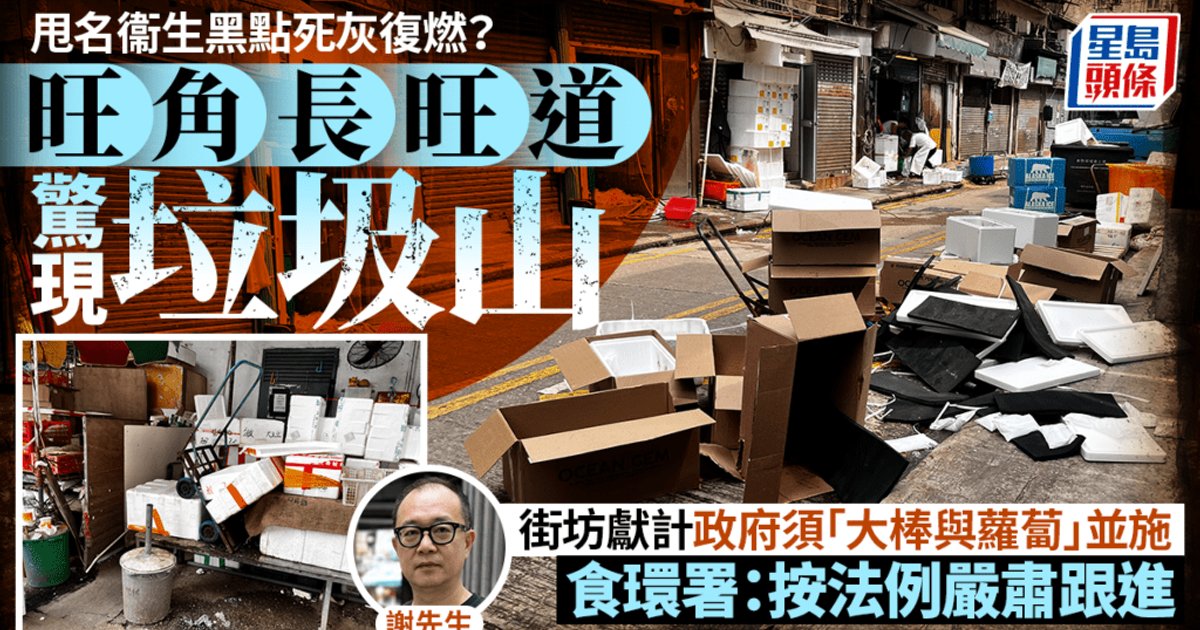
Former Hygiene Black Spots Resurface in Mong Kok Despite Government Crackdown
SingTao · 1 SOURCESabout 10 hours ago6 MIN
Summary
The government's "Campaign Against Hygiene Black Spots" launched in August 2022 has significantly reduced the number of designated problem sites from over 730 at its peak to just 57 currently . However, a Sing Tao investigation in August found that some delisted black spots in Mong Kok and Sham Shui Po are showing signs of recurrence, with garbage accumulation, foam boxes, and shop obstruction issues reappearing on streets near the old Mong Kok Market and Pei Ho Street Market . The Food and Environmental Hygiene Department (FEHD) confirmed it has been conducting enhanced surprise inspections and enforcement in these areas since August 2025, having taken a total of 297 enforcement actions in Mong Kok locations and 1,155 in Sham Shui Po .
Key Points
- Mong Kok's Cheung Wong Tao (長旺道) garbage collection station, which was removed from the black spot list, is now piled high with foam boxes, cardboard, and fruit packaging
- FEHD conducted 297 enforcement actions in Mong Kok wet market areas from August 2025 to July 2026, including 221 for illegal garbage dumping and 76 for shop obstruction
- Sham Shui Po saw even more enforcement, with 1,155 total actions, comprising 994 for illegal dumping and 161 for shop obstruction during the same period
- The Yau Tsim Mong district currently has 9 hygiene black spots, while Sham Shui Po has 3, down from over 730 combined at the program's peak
- Local legislator Chan Hoi-yan (陳凱欣) recommends adopting Foshan's model of cleaning streets every two hours and introducing "Green@Community" reward points for merchants who recycle properly
Why It Matters
The recurrence of hygiene problems in previously cleaned areas highlights the challenge of sustaining environmental improvements in Hong Kong's dense wet market districts, where limited shop space and misaligned waste collection schedules make it difficult for vendors to store recyclables properly . Without addressing these structural issues through increased cleaning frequency, enhanced recycling incentives, and stronger enforcement, the city risks seeing more delisted black spots relapse, undermining public confidence in government sanitation efforts .
The recurrence of hygiene problems in previously cleaned areas highlights the challenge of sustaining environmental improvements in Hong Kong's dense wet market districts, where limited shop space and misaligned waste collection schedules make it difficult for vendors to store recyclables properly . Without addressing these structural issues through increased cleaning frequency, enhanced recycling incentives, and stronger enforcement, the city risks seeing more delisted black spots relapse, undermining public confidence in government sanitation efforts .