Two American Economists Share 2026 Nobel Prize in Economics for Stabilization Research
Crhk · 4 SOURCES1 minute ago2 MIN
Summary
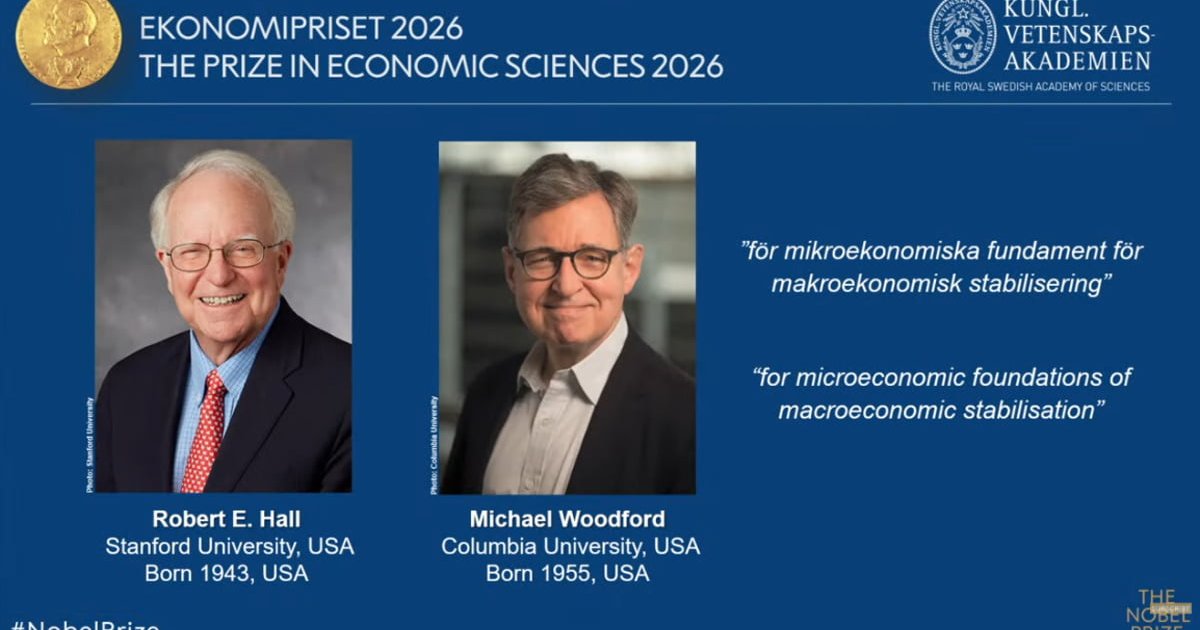
The 2026 Nobel Prize in Economic Sciences has been awarded to two American scholars, Robert E. Hall and Michael Woodford, for their groundbreaking work that laid the microeconomic foundations for macroeconomic stability policies . The Royal Swedish Academy of Sciences recognized that the models developed by these economists have significantly enhanced the ability to implement effective stabilization policies . The laureates will share prize money of 12 million Swedish kronor, approximately 1.22 million US dollars . The award committee highlighted that their New Keynesian models explaining how quantitative stabilization policies affect business cycles are now widely adopted by central banks and finance ministries globally .
Key Points
- Robert E. Hall, born 1943 in California, earned his PhD from MIT in 1967 and currently serves as a professor at Stanford University .
- Michael Woodford, born 1955 in Massachusetts, received his PhD from MIT in 1983 and is a professor at Columbia University .
- Their New Keynesian models explain how quantitative stabilization policies affect business cycles .
- The economists rebuilt models based on individual household and firm behavior rather than statistical correlations between macroeconomic variables like inflation and output .
- Their research demonstrates that when governments and central banks communicate policy plans, they can influence public expectations and guide economic direction .
Why It Matters
Before Hall and Woodford's contributions, Keynesian stabilization policies appeared to fail during the 1970s oil crisis, leading many to conclude such interventions caused more harm than good . Today, their models are widely adopted by central banks and finance ministries globally, directly shaping how authorities manage economic fluctuations to prevent recessions and control inflation . Their work shows that policy expectations themselves can influence economic outcomes, providing a crucial tool for governments navigating economic shocks.
Before Hall and Woodford's contributions, Keynesian stabilization policies appeared to fail during the 1970s oil crisis, leading many to conclude such interventions caused more harm than good . Today, their models are widely adopted by central banks and finance ministries globally, directly shaping how authorities manage economic fluctuations to prevent recessions and control inflation . Their work shows that policy expectations themselves can influence economic outcomes, providing a crucial tool for governments navigating economic shocks.