Officials tie five-year plan to public welfare
SingTao · 1 SOURCESabout 2 hours ago6 MIN
Summary
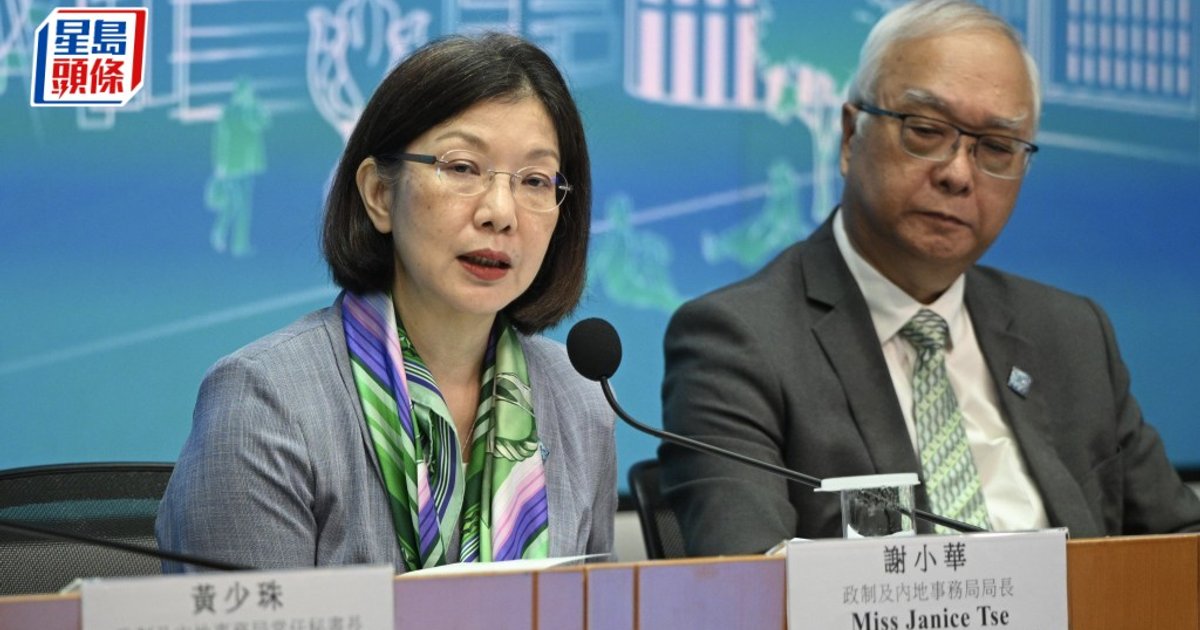
Secretary for Constitutional and Mainland Affairs Tse Siu-wa (謝小華) and Secretary for Environment and Ecology Tse Chin-wan (謝展寰) held a press conference on September 21 on Hong Kong’s first five-year plan and the Policy Address, focusing on Greater Bay Area development and green transition. Tse Siu-wa said the most important direction in drafting the plan is to put residents’ well-being first and to help more people feel hopeful about Hong Kong’s future development. She described the plan as a major step by the Hong Kong SAR government to uphold and improve executive-led governance and raise governing efficiency, noting that this year marks the start of the national 15th Five-Year Plan. Tse Chin-wan said the five-year plan and the Policy Address are aligned as forward-looking, strategic and directional guiding documents
Key Points
- Tse Siu-wa said the Constitutional and Mainland Affairs Bureau’s work in the coming year will include stronger innovation and technology cooperation and deeper coordination with central ministries and other Greater Bay Area cities
- She said priorities also cover infrastructure “hard connectivity”, rules and mechanisms “soft connectivity”, and “people-to-people connectivity” among residents of Hong Kong, Macau and mainland cities
- Tse Siu-wa said the plan is people-centred rather than a command economy, combining an efficient market with a proactive government under executive-led governance
- She cited the Northern Metropolis as an example of government guiding market development, while advancing education, industry landing and joint scientific research development
- On consultation, Tse Siu-wa said more than 17,000 submissions were received, showing public concern and recognition that the plan is closely tied to society’s and individuals’ futures
Why It Matters
The government is framing its first five-year plan not as a rigid economic blueprint but as a policy tool to connect governance, regional integration and daily well-being. For Hong Kong residents, that means future policy debates are likely to be judged increasingly by whether official planning can translate Greater Bay Area and green-transition goals into visible benefits and stronger confidence about the city’s direction