Working Mother's Welfare Post Sparks Debate Over School Support Disparities
SingTao · 1 SOURCES1 day ago2 MIN
Summary
A working mother's viral social media post detailing welfare disparities at her daughter's school has sparked heated debate across Hong Kong. The anonymous post highlighted how students receiving CSSA benefits enjoy free lunches and tutorial support while working families must pay for these services themselves. The controversy has reignited the "lying flat" (giving up) discourse, with many middle-class parents questioning whether their efforts are being punished by social policy.
Key Points
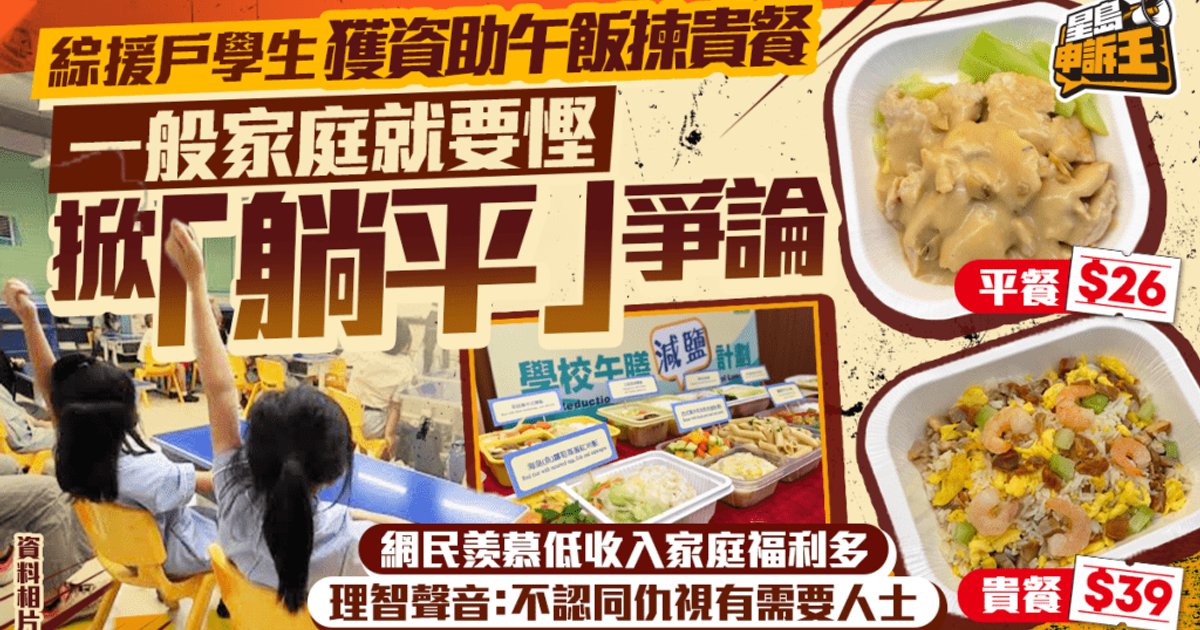
- An anonymous working mother posted on social media about her daughter's school offering two lunch options at HK$26 and HK$39, while CSSA recipients on the Education Bureau's Free Lunch scheme eat the HK$39 option for free
- The mother revealed she spends over HK$2,000 monthly on private tutorial classes, whereas CSSA students receive free after-school support under the School-based After-school Learning and Support Programme
- She stated that due to work commitments, she often misses quality time with her daughter, leading her to wonder if it would be easier to "lie flat and apply for CSSA"
- According to the Social Welfare Department, CSSA families receive fixed allowances for school-related expenses including books, meals, and transportation, with funds managed through schools
- Netizens also highlighted disparities in electronic devices, where CSSA students may receive brand-new tablets through programs like the Jockey Club e-Learning Support Programme, while paying families receive refurbished devices
Why It Matters
The debate reflects growing frustration among Hong Kong's "sandwich class" who feel caught between not qualifying for welfare yet struggling with the high cost of living. The controversy exposes tensions in how limited social resources are distributed and raises questions about work incentives in a city where housing and education costs remain prohibitively high for many families .
The debate reflects growing frustration among Hong Kong's "sandwich class" who feel caught between not qualifying for welfare yet struggling with the high cost of living. The controversy exposes tensions in how limited social resources are distributed and raises questions about work incentives in a city where housing and education costs remain prohibitively high for many families .