HKBU Dual Chinese Medicine Degree Blends AI and Humanistic Care
SingTao · 1 SOURCESabout 2 hours ago8 MIN
Summary
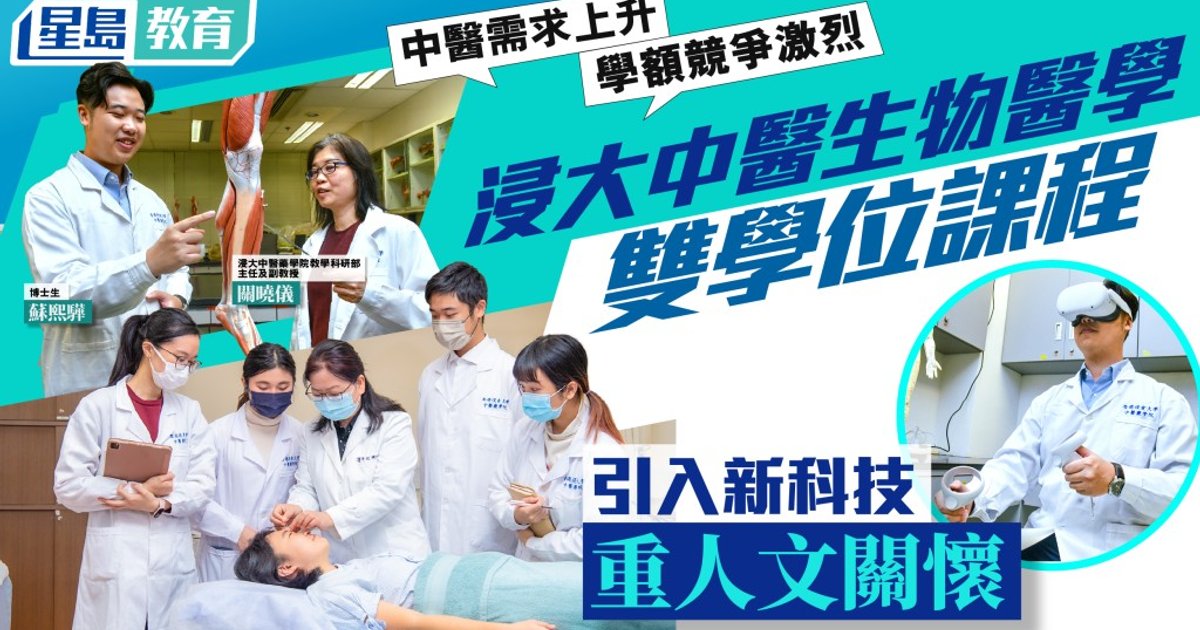
Hong Kong Baptist University's (HKBU) Chinese Medicine Bachelor's and Biomedical Science Bachelor's (Honours) dual-degree program is shaping the next generation of Chinese medicine practitioners by merging ancient healing traditions with cutting-edge technology. The six-year curriculum, which launched in autumn 1998 as the city's first University Grants Committee-funded full-time Chinese Medicine undergraduate program, prepares students for Hong Kong's unique dual Chinese-Western medicine landscape. HKBU's Teaching and Research Division Head and Associate Professor Guan Xiaoyi (關曉儀) emphasizes that while the program embraces artificial intelligence and virtual reality tools, the core mission remains deeply humanistic. Recent graduates like Su Xihua (蘇熙驊) have leveraged the program's research opportunities to pursue doctoral studies, demonstrating the pathway from undergraduate training to academic advancement. The Hong Kong Chinese Medicine Hospital, operated by HKBU and launched within the past year, has already expanded to offer 24-hour inpatient services by year-end, underscoring the sector's rapid growth.
Key Points
- HKBU's dual-degree program is a six-year course established in 1998, the first UGC-funded Chinese Medicine undergraduate program in Hong Kong .
- The curriculum integrates Chinese medicine fundamentals—diagnosis through observation, listening, questioning, and pulse-taking—with Western biomedical knowledge including physiology and surgery .
- Recent technological upgrades include virtual reality tools for bone injury studies, a Chinese medicine terminology database, and AI-assisted diagnostic systems .
- Professor Guan Xiaoyi stresses that AI serves as a tool to enhance, not replace, clinical judgment, noting that practitioners ultimately bear responsibility for patient outcomes .
- Clinical training encompasses observation at HKBU's Chinese medicine clinics, internships at Guangdong Provincial Hospital of Chinese Medicine, and service learning components .
- Graduate Su Xihua is currently pursuing a Doctor of Pharmacy in Chinese Medicine at HKBU, focusing on new drugs for musculoskeletal diseases .
- The Hong Kong Chinese Medicine Hospital will launch 24-hour inpatient services by the end of 2026, reflecting growing demand for integrated healthcare .
- Medical ethics education prepares students to communicate treatment options with patients and respect their autonomy and preferences .
Why It Matters
As Hong Kong's first Chinese medicine hospital expands to 24-hour services, the demand for practitioners skilled in both traditional techniques and modern medical collaboration will intensify. HKBU's integrated approach—teaching students to navigate AI tools while maintaining ethical responsibility—positions graduates to bridge Chinese and Western medical practices effectively in an increasingly technology-driven healthcare environment . The program's emphasis on humanistic values ensures that technological advancement serves patients rather than replacing the essential doctor-patient relationship.
As Hong Kong's first Chinese medicine hospital expands to 24-hour services, the demand for practitioners skilled in both traditional techniques and modern medical collaboration will intensify. HKBU's integrated approach—teaching students to navigate AI tools while maintaining ethical responsibility—positions graduates to bridge Chinese and Western medical practices effectively in an increasingly technology-driven healthcare environment . The program's emphasis on humanistic values ensures that technological advancement serves patients rather than replacing the essential doctor-patient relationship.