G20 Finance Ministers Deadlocked: 19-1 Split Over China Trade, No Joint Communiqué Issued
HK01 · 2 SOURCES1 day ago2 MIN
Summary
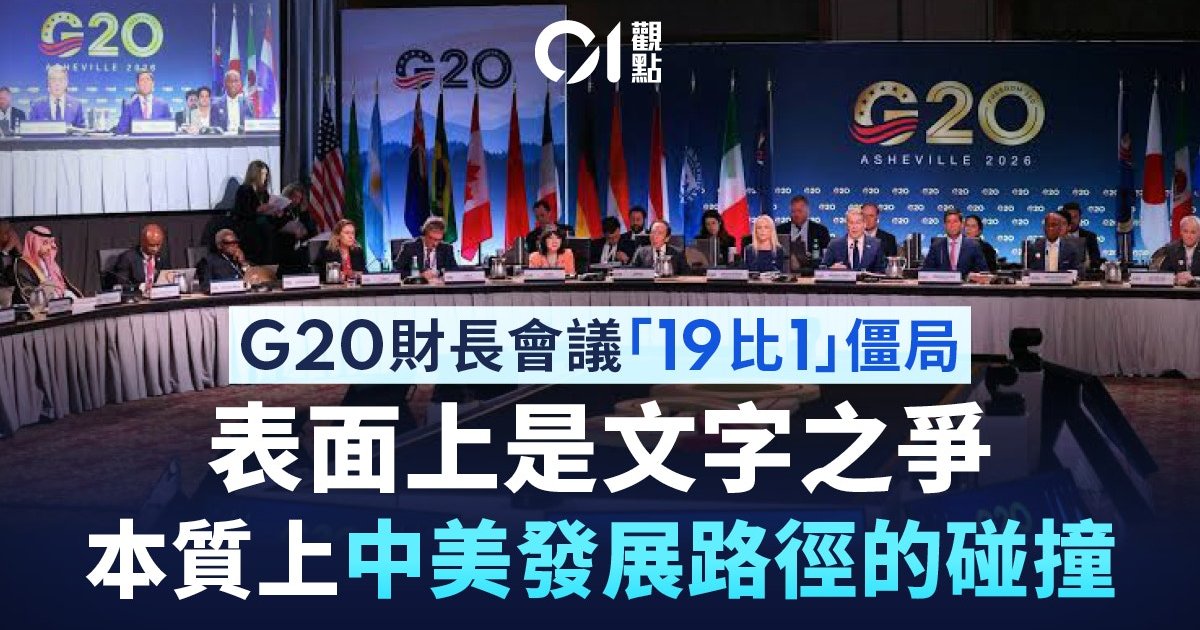
The G20 finance ministers' meeting in Asheville, North Carolina concluded on September 1, 2026, with a rare 19-1 deadlock, as China refused to join the consensus on addressing trade imbalances and non-market policies . US Treasury Secretary Scott Bessent accused China of being the sole dissenting member, arguing that its "unsustainable" current account surplus was destabilizing the global economy . The failure to produce a joint communiqué marks a significant setback for multilateral economic cooperation, with both sides hardening their positions on industrial policy and trade practices.
Key Points
- The G20 finance ministers meeting in Asheville, North Carolina on September 1 ended without a joint communiqué due to disagreements over China's trade surplus and non-market policies .
- US Treasury Secretary Bessent stated that China was the "dissenting voice" holding a 19-1 split, with all other members supporting measures to address export-driven growth and non-market practices .
- The proposed chairman's statement would require countries with persistent external surpluses to eliminate policies that restrict domestic consumption and create harmful spillover effects .
- On Iran, Bessent noted that the US and China share common ground—both agree Tehran should not possess nuclear weapons and that the Strait of Hormuz must maintain freedom of navigation .
- Global bond markets experienced significant turbulence during the meetings, with US 10-year Treasury yields approaching 4.8 percent and 30-year yields exceeding 5.2 percent .
- The chairman's statement also called for robust supply chains in critical minerals, energy, food, and fertilizers, amid Western concerns about China's potential weaponization of rare earth exports .
Why It Matters
The breakdown in G20 economic cooperation signals a deepening fracture between two competing visions for the global economic order . With global bond markets already spooked by sovereign debt concerns and the US federal debt exceeding $40 trillion, the inability of the world's largest economies to reach consensus on fundamental trade issues raises serious questions about future multilateral coordination . For Hong Kong, which serves as a gateway between Western and Chinese financial systems, this geopolitical fault line creates mounting pressure on businesses and investors to choose sides in an increasingly polarized economic landscape.
The breakdown in G20 economic cooperation signals a deepening fracture between two competing visions for the global economic order . With global bond markets already spooked by sovereign debt concerns and the US federal debt exceeding $40 trillion, the inability of the world's largest economies to reach consensus on fundamental trade issues raises serious questions about future multilateral coordination . For Hong Kong, which serves as a gateway between Western and Chinese financial systems, this geopolitical fault line creates mounting pressure on businesses and investors to choose sides in an increasingly polarized economic landscape.