Government Bailout Logic: Which Listed Companies Get Saved First
SingTao · 1 SOURCES1 day ago7 MIN
Summary
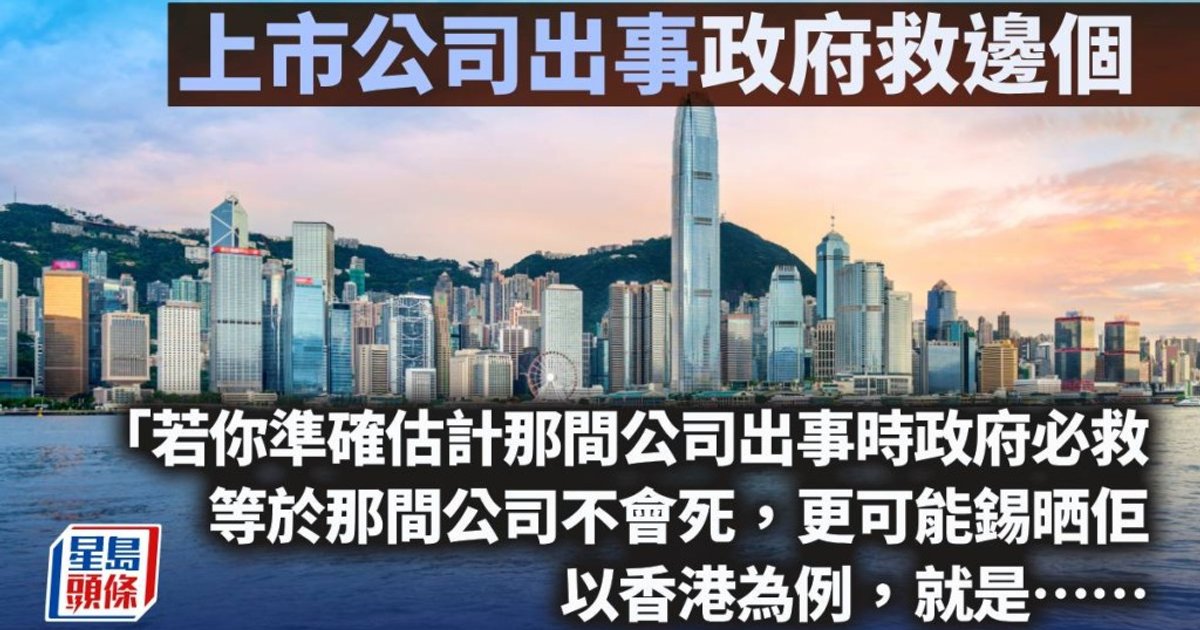
Renowned financial columnist Tsang Chi-hua (曾智華) argues that stock market participants must develop the analytical capability to determine which listed companies the government would rescue in times of crisis, as authorities typically view the collapse of strategically important firms as more damaging to themselves than the cost of intervention. In a discussion with a fellow investment veteran, Tsang emphasizes that when opportunities are unclear or market conditions volatile, investors should adopt the defensive stance famously advocated by Hong Kong tycoon Li Ka-shing's son Victor Li (李澤鉅): "If you don't understand it, don't rush in." The column identifies sectors deemed critical to public welfare—banking, healthcare, transportation, energy, and communications—where governments historically intervene to prevent systemic failures, citing the 2008 global financial crisis when Washington rescued major banks to prevent economic contagion.
Key Points
- Financial commentator Tsang Chi-hua advocates a cautious investment approach, recommending that retail investors wait for rare opportunities rather than constantly trading
- Tsang endorses the "ten criteria" framework for stock selection, warning that investors failing to meet at least five criteria should abstain from purchasing
- The core investment thesis emphasizes that strategically important companies benefit from implicit government backing, as authorities would suffer more from their failure than from bailout costs
- Hong Kong-listed Cathay Pacific (stock code 293) and Hong Kong Exchanges and Clearing (stock code 388) are cited as examples of firms the government would prioritize for rescue
- Students in investment courses are assigned to analyze which companies the Chinese government would rescue first across critical sectors including banking, healthcare, transportation, energy, communications, pharmaceuticals, chemicals, logistics, electricity, tourism, building materials, and mining
Why It Matters
For Hong Kong investors, understanding the implicit safety net surrounding strategically vital enterprises offers a practical framework for risk management during market volatility. This analysis extends beyond individual stock picking to macroeconomic policy anticipation, helping retail participants align their portfolios with government intervention patterns that could preserve capital during downturns. The distinction between companies the state considers "too important to fail" versus those left to market forces underscores the unique regulatory environment in which Hong Kong investors operate, particularly as mainland policy considerations increasingly influence market dynamics in the SAR.
For Hong Kong investors, understanding the implicit safety net surrounding strategically vital enterprises offers a practical framework for risk management during market volatility. This analysis extends beyond individual stock picking to macroeconomic policy anticipation, helping retail participants align their portfolios with government intervention patterns that could preserve capital during downturns. The distinction between companies the state considers "too important to fail" versus those left to market forces underscores the unique regulatory environment in which Hong Kong investors operate, particularly as mainland policy considerations increasingly influence market dynamics in the SAR.