Hong Kong Food Safety Centre Detects Formaldehyde in Taiwanese Rice Noodles
SingTao · 1 SOURCESabout 2 hours ago5 MIN
Summary
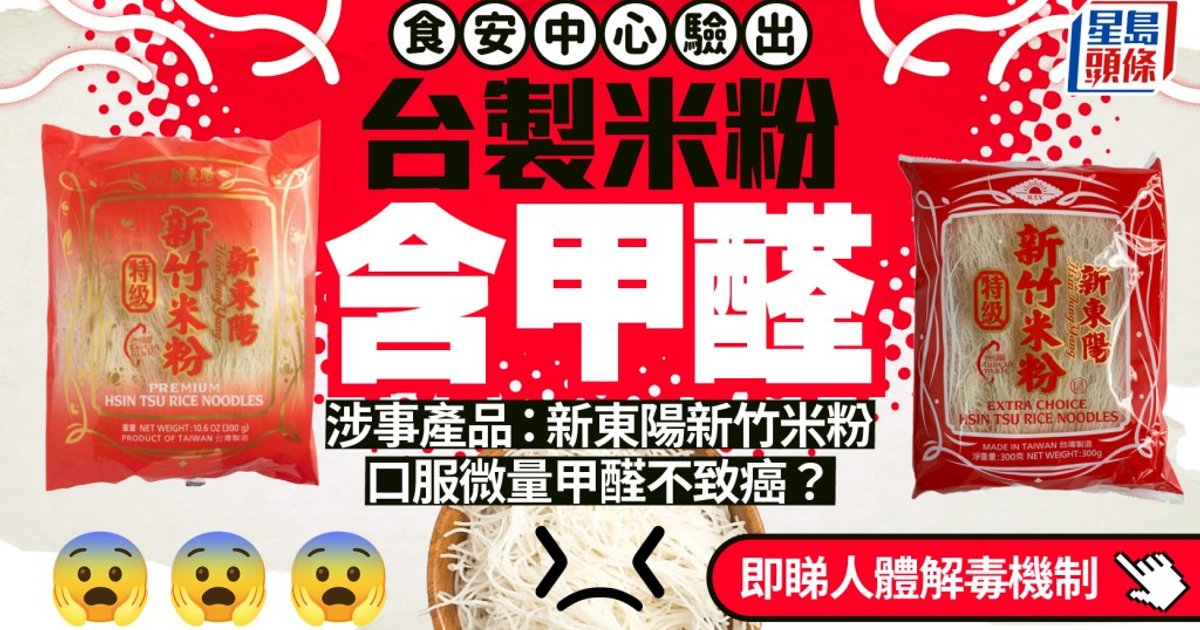
The Centre for Food Safety (CFS) in Hong Kong has detected trace amounts of formaldehyde in a batch of imported Taiwanese rice noodles, triggering an immediate recall. During routine monitoring, the authorities found the「新東陽新竹米粉」(New Tong Yang Hsinchu Rice Noodles) contained 12 parts per million (ppm) of formaldehyde. The affected product, with a net weight of 300 grams and best before date of April 10, 2029, was distributed by B&S Company. Authorities seized 450 boxes from the distributor's warehouse to prevent further sale. The Centre has advised the public not to consume the affected batch and has notified online retailers and distributors to remove the product from shelves immediately.
Key Points
- The「新東陽新竹米粉」(New Tong Yang Hsinchu Rice Noodles) contained 12 ppm formaldehyde, discovered during routine monitoring at an online store
- Authorities seized 450 boxes from B&S Company's warehouse and ordered complete removal from market
- International Agency for Research on Cancer classifies formaldehyde as a Group 1 carcinogen, though cancer risk primarily involves inhalation
- WHO assessment confirms oral ingestion of formaldehyde does not cause cancer, as the digestive system and liver rapidly metabolize it
- Hong Kong law prohibits formaldehyde as a food preservative; violators face HK$50,000 fine and six months imprisonment
Why It Matters
This incident highlights ongoing food safety concerns regarding imported products and the importance of routine monitoring in protecting public health. While the trace amount detected poses minimal direct health risk according to international assessments, the case underscores that even naturally occurring substances can become legal violations when added to food, reminding consumers to purchase from reputable retailers and follow proper food handling practices such as thorough washing and cooking .
This incident highlights ongoing food safety concerns regarding imported products and the importance of routine monitoring in protecting public health. While the trace amount detected poses minimal direct health risk according to international assessments, the case underscores that even naturally occurring substances can become legal violations when added to food, reminding consumers to purchase from reputable retailers and follow proper food handling practices such as thorough washing and cooking .