HKGAI Releases Open-Source Music Model YuE2, Outperforms Suno on Benchmarks
Bastillepost · 2 SOURCES1 day ago2 MIN
Summary
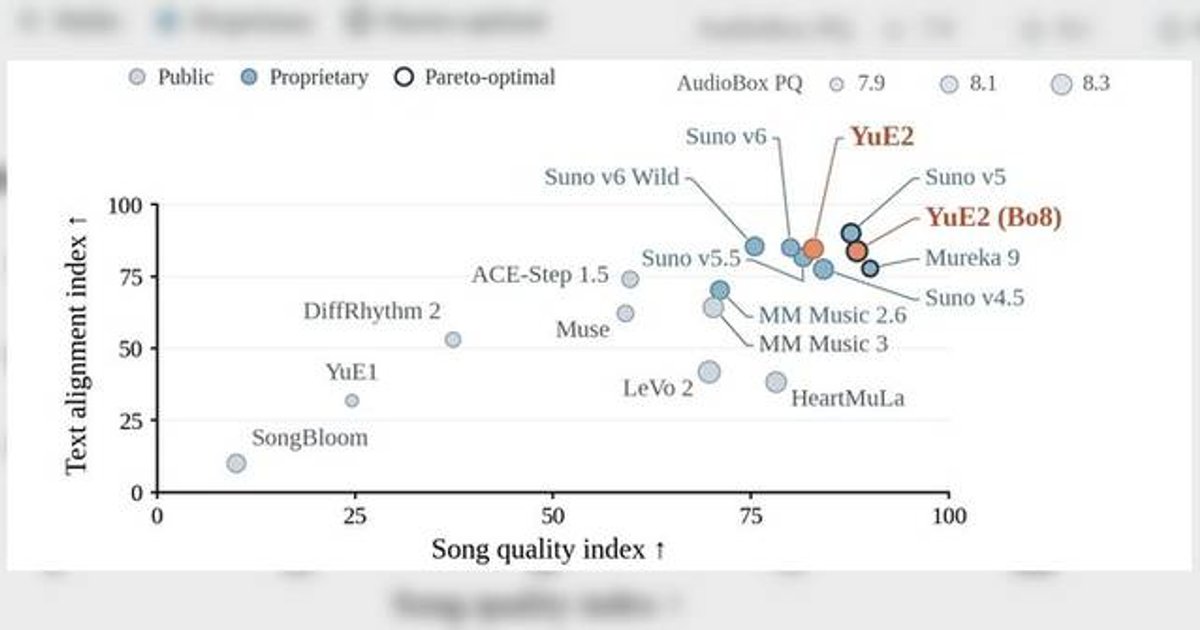
The Hong Kong Generative AI Research Centre (HKGAI) has unveiled YuE2, the world's first open-source music generation model employing a symbolic planning architecture. Within nine days of its September 18 launch, YuE2 climbed to fourth place on HuggingFace's platform-wide trending list, amassing approximately 179,000 cumulative downloads across its ecosystem. The model outperformed several leading commercial closed-source competitors on the WildSongBench evaluation benchmark .
Key Points
- YuE2 launched on September 18, 2026, ranking 4th on HuggingFace's overall trending chart with a trendingScore of 595, becoming the sole music model in the top five .
- The official main model recorded 11,626 downloads in nine days; combined with ComfyUI integration, community GGUF/quantized versions, and toolchains, total ecosystem downloads reached approximately 179,000 .
- The model separates "symbolic planning" from "acoustic rendering" using a mixture-of-experts approach, enabling creators to adjust individual notes without regenerating entire tracks .
- YuE2 supports six languages (Chinese, English, Japanese, Korean, Russian, Spanish) and over 60 music genres, generating 48kHz high-fidelity stereo audio .
- As an open-source release for non-commercial use, the model runs on a single consumer-grade graphics card, keeping user data local and accessible .
Why It Matters
YuE2's debut mirrors the disruptive impact of DeepSeek in the large language model domain, demonstrating that open-source communities can match or exceed proprietary systems . By giving musicians precise control over individual notes and arrangements while remaining resource-efficient, this technology transitions AI music from casual experimentation into a professional-grade production tool for composition, arrangement, and soundtrack creation .
YuE2's debut mirrors the disruptive impact of DeepSeek in the large language model domain, demonstrating that open-source communities can match or exceed proprietary systems . By giving musicians precise control over individual notes and arrangements while remaining resource-efficient, this technology transitions AI music from casual experimentation into a professional-grade production tool for composition, arrangement, and soundtrack creation .