Hong Kong EV registrations plunge after tax scheme ends
SingTao · 1 SOURCESabout 3 hours ago6 MIN
Summary
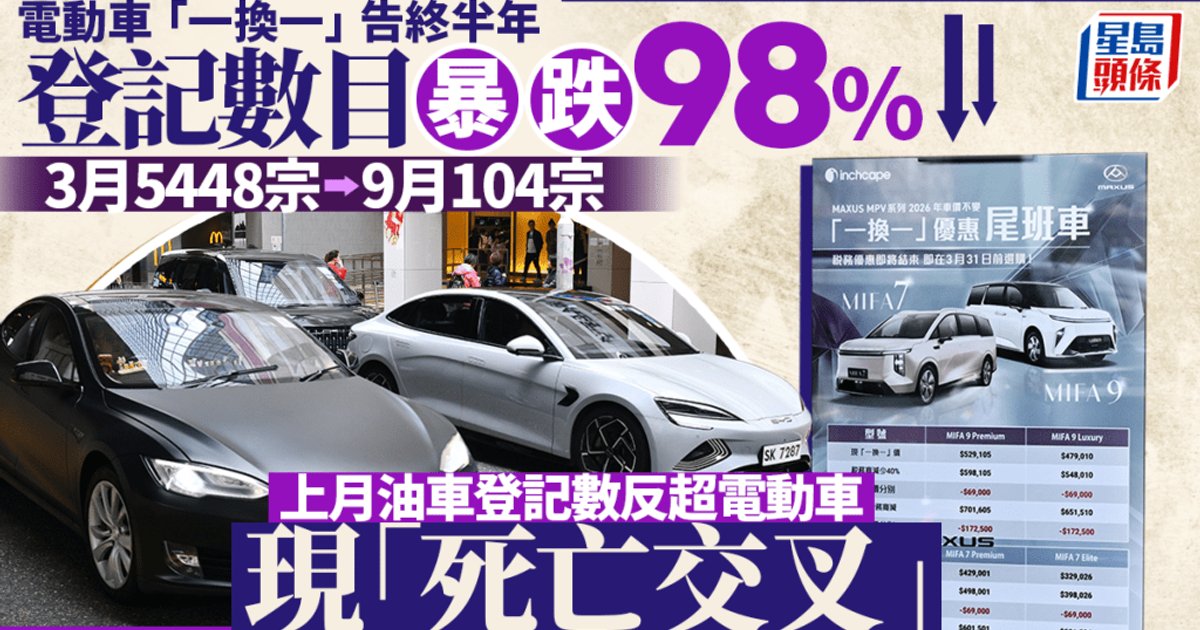
Hong Kong’s electric private-car market has slowed sharply after the government let the “one-for-one replacement” electric-vehicle tax concession expire on March 31, 2026. Transport Department figures obtained by Sing Tao show that only 104 electric private cars were first registered through the scheme in September, down about 98% from 5,448 in March, when buyers rushed to beat the deadline. In the broader market, 1,316 electric private cars and 1,382 petrol-powered private cars, including hybrid and plug-in hybrid models, were newly registered in September, giving petrol vehicles a 51.22% share and electric vehicles 48.78%. The September crossover ended several years in which electric cars had dominated new private-car registrations
Key Points
- The government first launched the “one-for-one replacement” plan in the 2018 Budget, offering eligible owners up to HK$250,000 in first-registration-tax relief for scrapping an old private car and buying a new electric one
- After the 2026 Budget said the scheme would not be extended beyond March 31, buyers rushed in, and the Transport Department received about 13,500 applications in March alone
- The department said it added manpower and completed all approvals in May; from March to May, about 16,000 applications completed first registration, with April the busiest month at 6,427 cases
- September saw 2,698 newly registered private cars in total, including 1,382 petrol vehicles and 1,316 electric vehicles, marking the first recent month in which petrol registrations overtook electric ones
- Veteran motoring figure Lee Yiu-pui (李耀培) said many September petrol registrations were likely hybrids or plug-in hybrids, as dealers pushed them in the post-subsidy market and some drivers still lack convenient charging access at home
Why It Matters
The latest figures suggest Hong Kong’s electric-car adoption remains highly sensitive to tax policy, even as officials argue the technology and pricing are now competitive. They also point to a practical constraint for many households: without easier charging access in high-rise living environments, some buyers may continue to choose hybrid models or delay switching altogether