West Kowloon Leads Hong Kong Office Decentralisation Wave
On.cc · 3 SOURCES1 day ago10 MIN
Summary
Knight Frank's latest Hong Kong office report says companies are reassessing where to locate their offices as Central's top-tier rents recover sharply and vacancy falls. From 2024 to the third quarter of 2026, more than 896,126 square feet of committed net floor area moved out of Central, Admiralty and Sheung Wan, with West Kowloon taking the largest share. The report also says the market is splitting into two parallel trends: decentralisation away from Central and a return by some occupiers seeking to secure core space before rents climb further.
Key Points
- Central super-prime office rents rebounded 28.8% from their August 2025 low to about HK$130 per square foot by September 2026.
- Vacancy in Central super-grade offices fell from about 14.5% at the start of 2026 to 6.9% in September.
- International Finance Centre One and Two were described as close to fully let, underscoring tightening supply in flagship Central towers.
- Companies moving from Central to West Kowloon, Causeway Bay or Quarry Bay can save roughly HK$35 to HK$66 per square foot in rent.
- West Kowloon accounted for about 78% of 896,126 square feet relocated from Central, Admiralty and Sheung Wan, involving seven major cases.
- Knight Frank's deeper breakdown found three distinct relocation patterns across the core districts. For Central alone, about 90% of committed net floor area leaving the district went to West Kowloon, covering five major relocation cases and more than 503,857 square feet. The consultancy said this suggests occupiers are not simply chasing cheaper non-core space, but are prioritising large contiguous floor plates, high-specification buildings and the transport advantage of the high-speed rail link in West Kowloon.
- In Sheung Wan, about 357,099 square feet of office space moved out, with West Kowloon taking about 43%, or around 154,411 square feet. Central absorbed another roughly 18% of Sheung Wan's relocated area, indicating that some firms used the earlier rent downturn to upgrade into the traditional core district. Other occupiers from Sheung Wan moved to Wan Chai and Wong Chuk Hang in search of more cost-effective offices.
- Admiralty showed a different pattern, with relocations still concentrated within core districts rather than a wholesale move outward. Central and Wan Chai accounted for 38% and about 32% respectively of Admiralty's outward relocation area, while West Kowloon took about 16%. Knight Frank said this points to occupiers valuing proximity to government departments and major institutions alongside rent and floor space considerations.
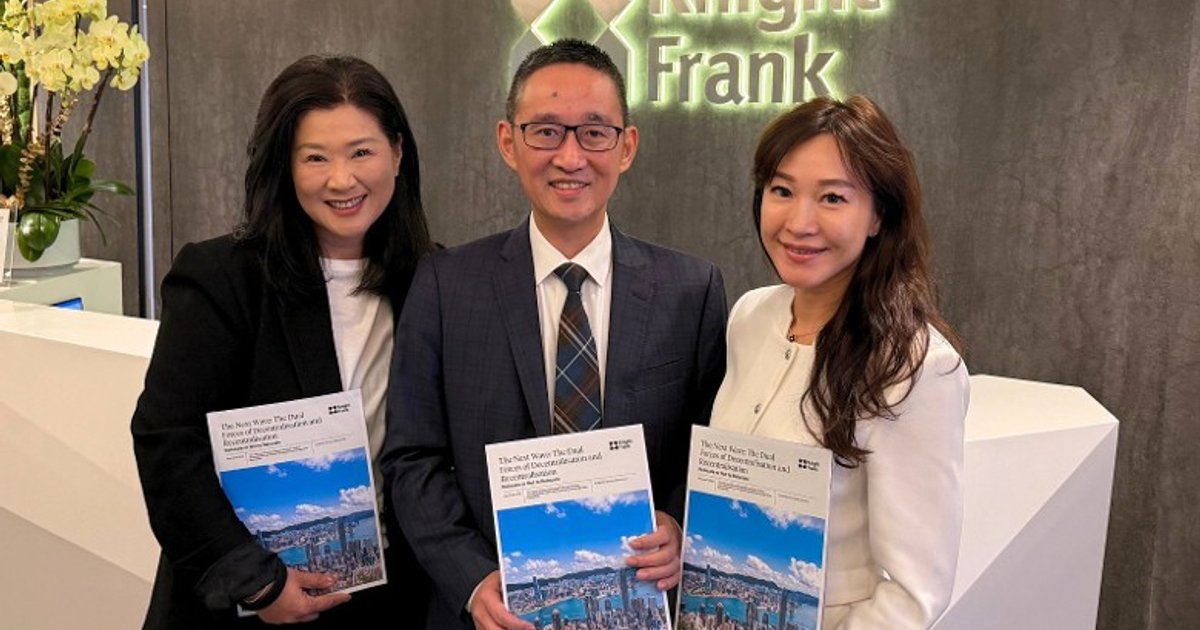
- The report said West Kowloon's Grade A office stock has risen to more than 4.2 million square feet following the completion of International Gateway Centre and the West Kowloon Art Park tower, improving the district's ability to accommodate large corporate occupiers. Knight Frank executive director and head of Hong Kong office services Dennis Lau Pak-man (劉柏汶) said the market is not moving in only one direction, while executive director and head of Kowloon office services Ng Chi-fung (吳志峰) said more companies are being drawn by West Kowloon's quality buildings, larger floor plates and cost efficiency. Director and head of Greater China research and consultancy Ada Liu Mei-shan (廖美珊) said West Kowloon and Causeway Bay are likely to be the main beneficiaries of the decentralisation trend.
Why It Matters
For Hong Kong businesses, the report points to a narrower window to secure premium Central space at current rents, while also reinforcing West Kowloon as a serious alternative for large occupiers. The split between firms returning to Central and others relocating outward could reshape leasing demand, rental pricing and the balance between traditional and emerging office districts.