Post-90s Chinese Entrepreneurs Launch US Robot Startup Specializing in Laundry, Napkin Folding
SingTao · 1 SOURCESabout 3 hours ago2 MIN
Summary
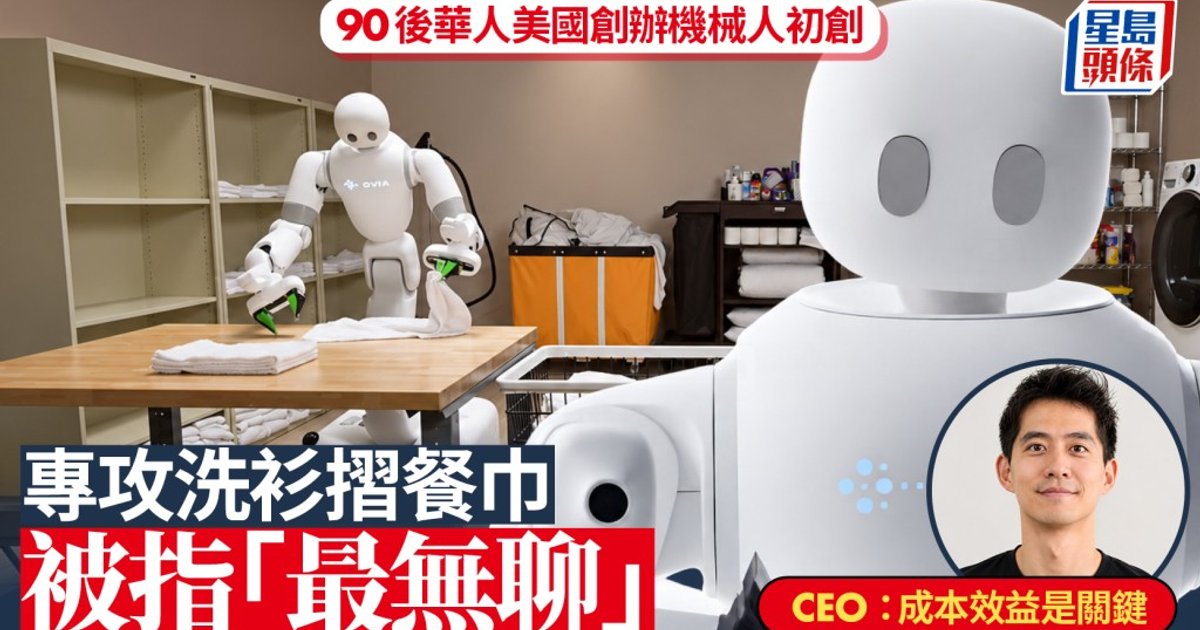
While many robots showcase impressive dancing and high-difficulty maneuvers to capture attention, American startup Dyna Robotics has gained recognition for its robots that fold napkins and handle laundry, earning the title of the world's most boring robot from US media. Yet co-founder and CEO Lindon Gao considers this seemingly dismissive label a form of highest praise. He explained that a robot's value lies not in flashy movements but in its ability to consistently perform work and generate tangible returns for clients. Some of Dyna's clients have already reduced related labor costs by 40% to 50%.
Key Points
- Dyna Robotics was co-founded in 2024 by three post-90s Chinese entrepreneurs: Lindon Gao, Ma Yecheng, and Yang Shiyuan, launching their semi-humanoid robot Taku in September 2026
- The Taku robot can autonomously complete laundry retrieval, washing, drying, and folding for approximately one hour without human intervention, as demonstrated in unedited footage
- In September 2025, Dyna completed a $120 million Series A funding round led by RoboStrategy, CRV, and First Round Capital, with participation from NVentures, Amazon Industrial Innovation Fund, and Salesforce Ventures, valuing the company at over $600 million
- In August 2026, Din Tai Fung in the United States deployed the DYNA-2 robot for napkin folding, achieving approximately 95 napkins per hour with a 93% pass rate, and expanded the deployment across multiple locations
- The company prioritizes commercial scenarios like restaurants and hotels where workflows are highly standardized, making cost-benefit analysis clearer compared to household environments
Why It Matters
Dyna's success demonstrates that robotics companies can build sustainable businesses by focusing on practical, high-frequency commercial applications rather than pursuing flashy but unprofitable use cases. This pragmatic approach may accelerate the timeline for affordable home robots. If costs drop to around HK$30,000 as the CEO projects, ordinary families could soon benefit from automated domestic assistance . The broader implication is that AI and robotics will reshape how humans allocate time and labor, with the key question being who controls this transformative technology .
Dyna's success demonstrates that robotics companies can build sustainable businesses by focusing on practical, high-frequency commercial applications rather than pursuing flashy but unprofitable use cases. This pragmatic approach may accelerate the timeline for affordable home robots. If costs drop to around HK$30,000 as the CEO projects, ordinary families could soon benefit from automated domestic assistance . The broader implication is that AI and robotics will reshape how humans allocate time and labor, with the key question being who controls this transformative technology .