CUHK Reveals Mechanism of Natural Bypass Artery Formation in Damaged Hearts
SingTao · 2 SOURCESabout 2 hours ago3 MIN
Summary
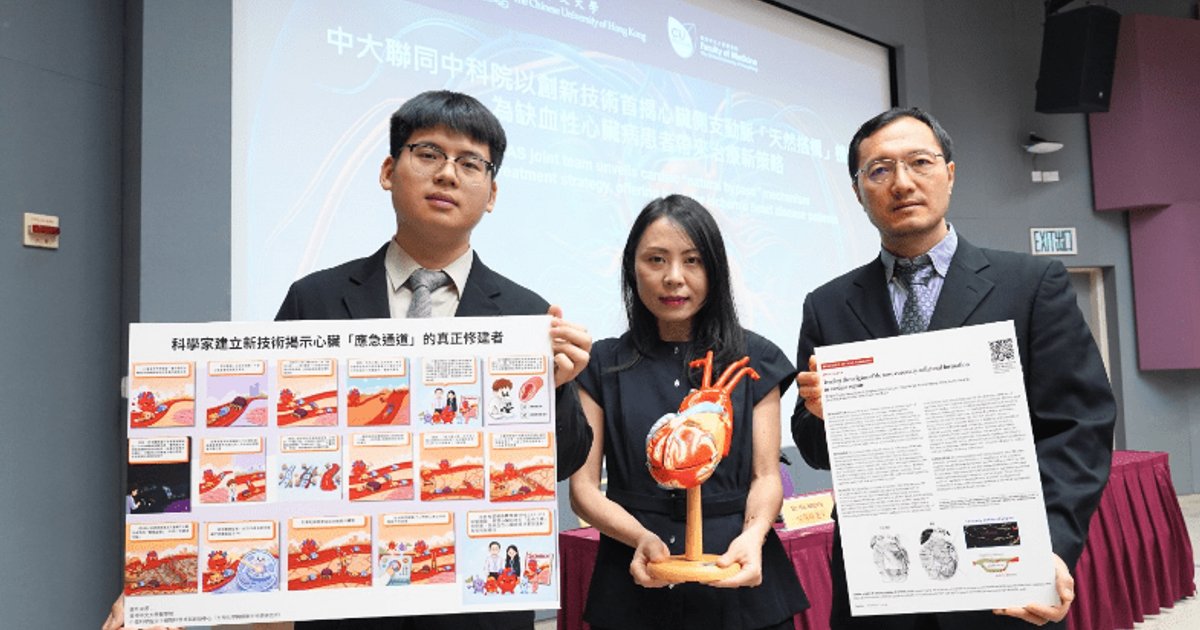
Researchers from CUHK Medical School and the Chinese Academy of Sciences have made a groundbreaking discovery about how the heart naturally protects itself against coronary artery blockages. By developing an innovative genetic lineage tracing technique called the "cell contact history recorder," the team successfully identified the cellular origins of collateral artery formation for the first time. Their findings reveal that when coronary arteries become blocked, capillaries—normally small vessels akin to "side streets"—undergo rapid transformation into larger collateral arteries serving as "natural emergency bridges." The research further established that vascular endothelial growth factor A (VEGFA) acts as the critical trigger for this process, with the transcription factor YY1 directing the cellular conversion. This discovery opens new avenues for treating ischemic heart disease without invasive surgical interventions.
Key Points
- The research team developed a novel genetic lineage tracing technology capable of permanently labeling specific cells and tracking their developmental trajectories to overcome previous technical limitations
- Approximately 80 percent of newly formed collateral arteries originate from capillaries, while the remaining 20 percent derive from arterial endothelial cells, directly challenging the previous academic assumption
- When the coronary artery ("highway") becomes blocked, capillaries ("side streets") activate an "upgrade project," progressively widening and strengthening to form new collateral arteries
- VEGFA was identified as the key factor driving collateral artery formation; experiments in mice showed that temporarily elevating VEGFA levels significantly reduced myocardial ischemic range while improving cardiac function
- An mRNA-based treatment strategy using modified VEGFA messenger RNA (VEGFA modRNA) is already in Phase 2 clinical trials in Europe and the United States, with plans to expand research to the Greater Bay Area
Why It Matters
This research provides crucial insights into the body's natural protective mechanisms against heart disease, potentially offering patients a less invasive alternative to coronary stenting or open-heart bypass surgery. The identification of VEGFA as a therapeutic target and the ongoing clinical trials suggest that a new class of treatments for ischemic heart disease—Hong Kong's third leading cause of death—could become available within the coming years, benefiting millions of patients globally who are unsuitable for traditional surgical interventions .
This research provides crucial insights into the body's natural protective mechanisms against heart disease, potentially offering patients a less invasive alternative to coronary stenting or open-heart bypass surgery. The identification of VEGFA as a therapeutic target and the ongoing clinical trials suggest that a new class of treatments for ischemic heart disease—Hong Kong's third leading cause of death—could become available within the coming years, benefiting millions of patients globally who are unsuitable for traditional surgical interventions .