Volleyball Injury Expert Reveals Top 5 Hazards: Shoulder, Knee, Ankle Most Vulnerable
SingTao · 1 SOURCESabout 2 hours ago2 MIN
Summary
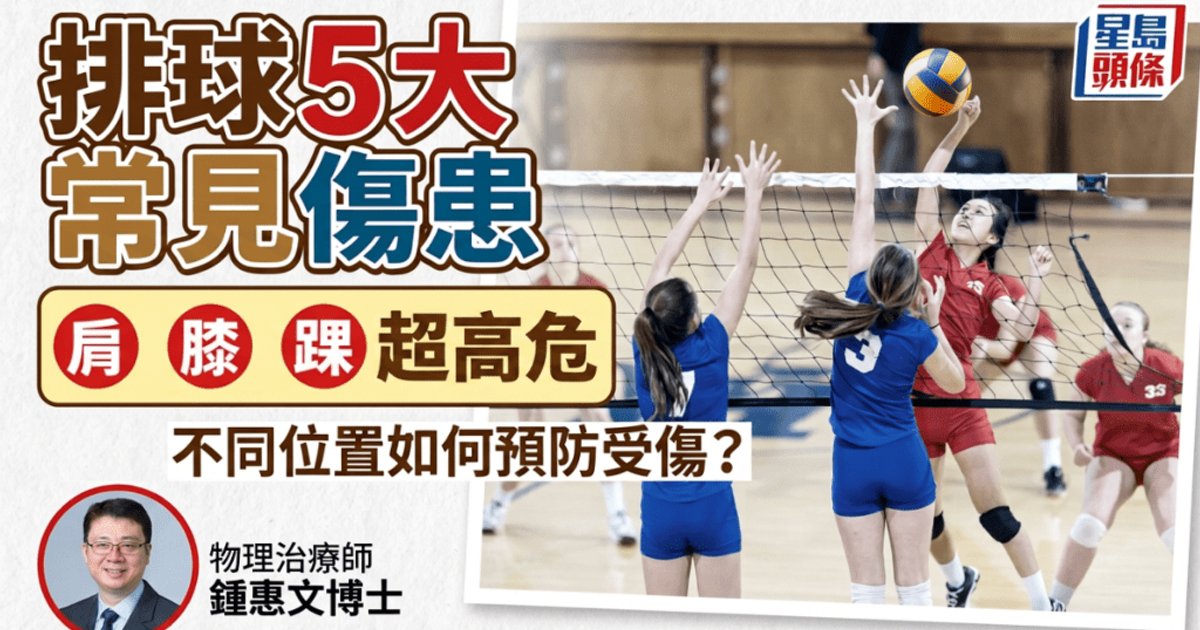
Volleyball, alongside football and basketball, ranks among Hong Kong's most popular ball sports, yet the game carries hidden injury risks that many players overlook. Physical therapist Dr. Chung Wai-man emphasizes that despite minimal body contact, volleyball involves high-frequency jumping and repetitive upper limb movements that lead to chronic overuse injuries rather than acute trauma. International sports medicine research reveals that volleyball athletes' injuries cluster around three main joints: the shoulder, knee, and ankle.
Key Points
- Elite volleyball players perform hundreds of jumps per week, placing substantial cumulative stress on the patellar tendon and ankle ligaments .
- Spiking and serving involve high-speed shoulder external and internal rotation, with attackers and middle blockers showing significantly higher shoulder pain rates than other positions .
- Rotator cuff tendinitis, shoulder impingement syndrome, and partial tears develop from repeated arm swinging when scapular stabilizers are neglected .
- Jumper's knee (patellar tendinitis) affects 20 to 40 percent of elite volleyball players, with early symptoms presenting as post-exercise kneecap pain .
- Ankle sprains constitute a major proportion of volleyball's acute injuries; inadequate rehabilitation significantly increases re-injury risk and may progress to chronic instability .
Why It Matters
For Hong Kong's school and district volleyball community, these findings underscore the importance of position-specific training regimens rather than generic fitness programs. Dr. Chung stresses that taping serves only as supplementary support and cannot substitute for proper strength and movement training—ensuring athletes can enjoy the sport sustainably without chronic pain .
For Hong Kong's school and district volleyball community, these findings underscore the importance of position-specific training regimens rather than generic fitness programs. Dr. Chung stresses that taping serves only as supplementary support and cannot substitute for proper strength and movement training—ensuring athletes can enjoy the sport sustainably without chronic pain .