French, Japanese Scientists Win 2026 Nobel Chemistry Prize for Asymmetric Synthesis Discovery
SingTao · 2 SOURCESabout 3 hours ago2 MIN
Summary
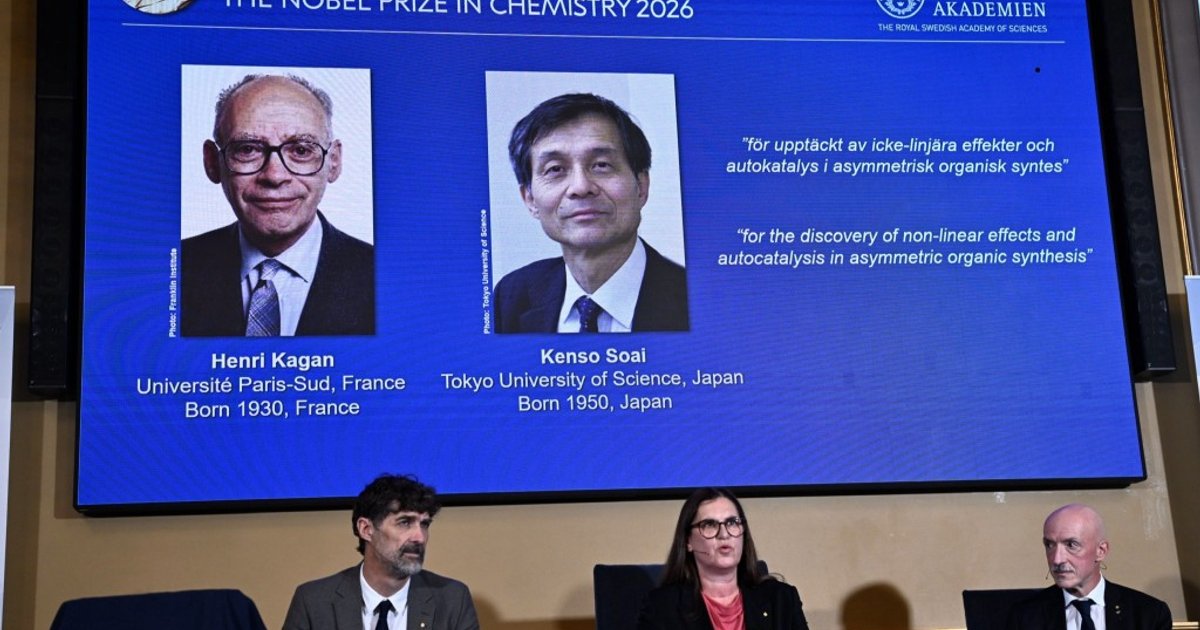
The 2026 Nobel Prize in Chemistry was announced on Wednesday, October 7, at approximately 5:45 PM, awarded jointly to French chemist Henri Kagan and Japanese organic chemist Kenso Soai for their discoveries of non-linear effects and autocatalysis in asymmetric organic synthesis. Their pioneering work solved a century-old chemical puzzle: how nature spontaneously produces homochirality, where living organisms contain only one mirror-image form of molecules like amino acids. The two scientists will share the prize of 12 million Swedish kronor .
Key Points
- Henri Kagan and Kenso Soai jointly awarded 2026 Nobel Prize in Chemistry for discoveries in asymmetric organic synthesis
- Prize announcement at 5:45 PM on October 7, winners to share 12 million Swedish kronor
- Kagan pioneered non-linear effects in 1986, showing tiny mirror biases can be amplified to produce single mirror molecules
- Soai designed the first homochirality-potential reaction in 1995 and achieved the self-replicating Soai reaction in 2003
- Their discoveries enable pharmaceutical companies to manufacture drugs with only the therapeutically effective mirror form
Why It Matters
Their discoveries have transformed how chemists design pharmaceutical compounds, as most drugs are effective in only one mirror-image form. The Nobel Chemistry Prize is traditionally regarded as the most unpredictable award due to its broad scope covering organic synthesis, biochemistry, nanotechnology, and increasingly computational chemistry and AI applications . This recognition highlights how fundamental research into chemical principles can yield practical breakthroughs for developing life-saving medications.
Their discoveries have transformed how chemists design pharmaceutical compounds, as most drugs are effective in only one mirror-image form. The Nobel Chemistry Prize is traditionally regarded as the most unpredictable award due to its broad scope covering organic synthesis, biochemistry, nanotechnology, and increasingly computational chemistry and AI applications . This recognition highlights how fundamental research into chemical principles can yield practical breakthroughs for developing life-saving medications.