UN General Assembly Votes for 34th Consecutive Year to Urge US to End Cuba Blockade
SingTao · 3 SOURCESabout 5 hours ago2 MIN
Summary
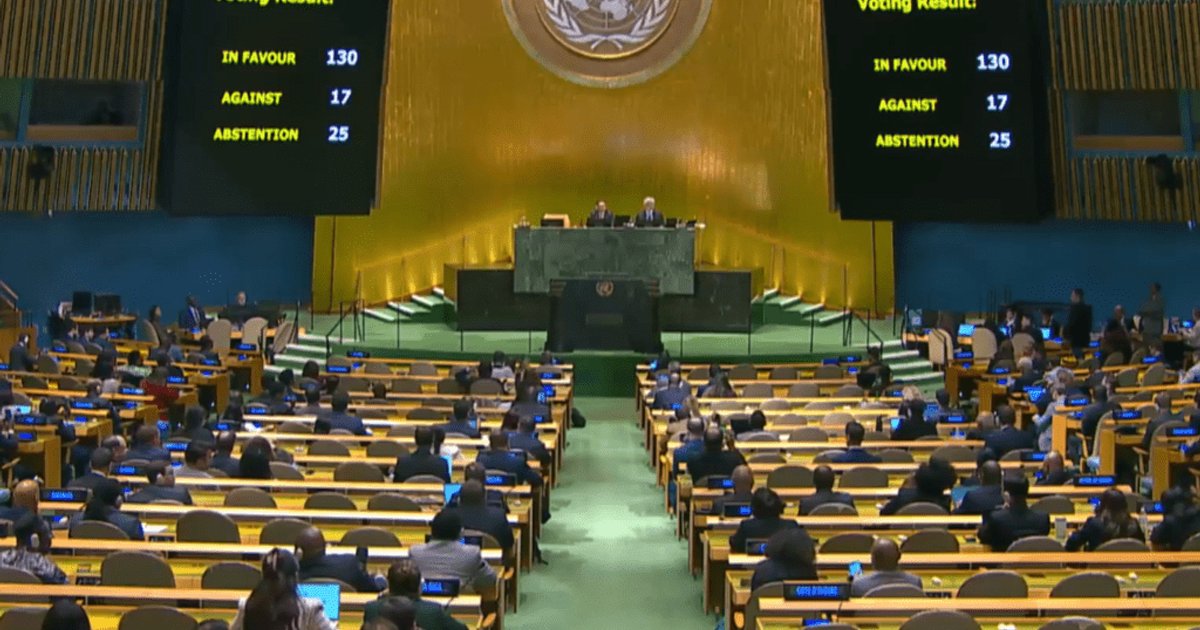
The United Nations General Assembly voted 130-17-25 on October 28, 2026, to demand the United States lift its six-decade embargo on Cuba, marking the 34th consecutive year such a resolution has passed . The vote came one day after a dramatic confrontation between US and Cuban delegates on the General Assembly floor, where words were exchanged over Cuba's human rights record and Washington's blockade policy . US Secretary of State Marco Rubio subsequently expelled a Cuban diplomat from the United Nations headquarters in New York, giving them 24 hours to leave the country . Cuban President Miguel Díaz-Canel celebrated the vote on social media, declaring that the Cuban people would never yield to American economic coercion .
Key Points
- The UN General Assembly resolution passed 130-17-25 with 25 abstentions on October 28, the 34th consecutive year the body has voted to condemn the US embargo
- Support for the resolution has declined significantly, dropping from 187 votes in favor in 2024 to 165 in 2025 and 130 this year
- US Ambassador to the UN Michael Waltz accused the Cuban government of persecuting citizens and confiscating property, prompting Cuban delegates to bang tables and stand in protest
- Cuban Foreign Minister Bruno Rodríguez led his delegation in confronting Waltz, who responded by saying: "This is the United Nations, not Havana — you cannot silence me here"
- Secretary of State Marco Rubio ordered a Cuban diplomat assigned to the UN to depart within 24 hours for allegedly assaulting a US official
Why It Matters
The annual UN vote serves as a barometer of global opinion on Washington's Cuba policy, with the declining 'yes' vote suggesting eroding international consensus on the issue . The diplomatic confrontation and subsequent expulsion order underscore the deep animosity between the two nations, even as multilateral institutions continue to register formal objections to the embargo . For Hong Kong, which maintains active economic ties across the Americas, the ongoing US-Cuba tensions illustrate how Cold War-era policies continue to complicate contemporary trade relations in the Western Hemisphere .
The annual UN vote serves as a barometer of global opinion on Washington's Cuba policy, with the declining 'yes' vote suggesting eroding international consensus on the issue . The diplomatic confrontation and subsequent expulsion order underscore the deep animosity between the two nations, even as multilateral institutions continue to register formal objections to the embargo . For Hong Kong, which maintains active economic ties across the Americas, the ongoing US-Cuba tensions illustrate how Cold War-era policies continue to complicate contemporary trade relations in the Western Hemisphere .