16-Year-Old Student Discovers AI System Flaws, Becomes HKGAI's First Secondary School Intern
SingTao · 2 SOURCES1 day ago6 MIN
Summary
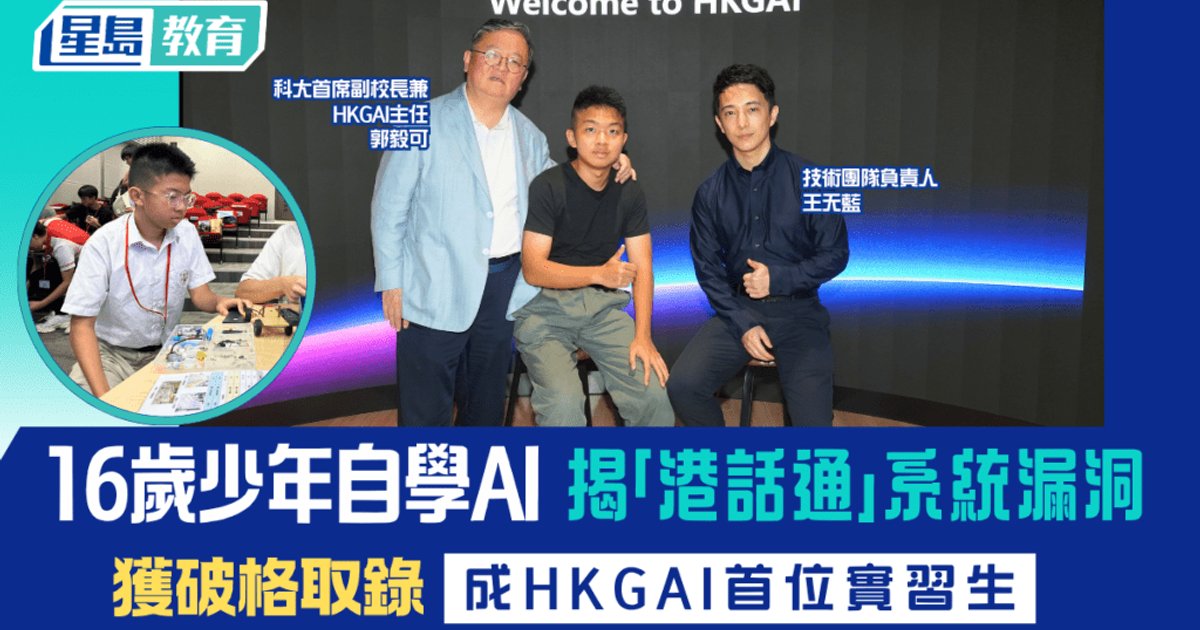
A 16-year-old secondary school student named Mak Kai-long (麥鈤朗) has become the first secondary school intern at the Hong Kong Generative AI Center (HKGAI) after independently discovering and reporting security vulnerabilities in the AI assistant platform "Hong Kong Talk" (港話通). His journey from self-taught AI enthusiast to collaborating with university-level researchers highlights the potential for young talent to contribute meaningfully to cutting-edge technology development in Hong Kong.
Key Points
- Mak Kai-long, 16, a Form Five student at a Wong Tai Sin district secondary school, began coding at age 14 and transitioned to AI at 15, learning through YouTube tutorials and using generative AI tools like Gemini for self-study
- In March 2026, he conducted independent security research on "Hong Kong Talk" using red team testing methods, including multi-round logic attacks and persona simulation attacks, discovering vulnerabilities within one week
- He submitted a detailed vulnerability report to HKGAI, which impressed technical team leader Wang Tianlan and led to a meeting with HKUST Chief Vice President Guo Yike in March
- Guo Yike personally invited Mak to join the team for a one-month internship starting late July, during which he discovered additional prompt leakage vulnerabilities and contributed to system improvements
- During his internship, Mak worked from 9 am to 6 pm daily on road testing, initially communicating with colleagues in English before switching to simplified Chinese for technical reports
- Wang Tianlan praised Mak's outspoken approach, noting that young people bring perspectives that professional developers cannot replicate, particularly regarding how Generation Z users interact with AI platforms
Why It Matters
This breakthrough demonstrates how Hong Kong's AI development ecosystem can engage young talent outside traditional academic pathways, with Guo Yike emphasizing that today's secondary school students are "AI natives" who naturally integrate AI into learning and problem-solving. HKGAI plans to open more than 100 application programming interfaces and agent environments to encourage more young people to participate in AI innovation, potentially reshaping how Hong Kong cultivates its next generation of technology talent .
This breakthrough demonstrates how Hong Kong's AI development ecosystem can engage young talent outside traditional academic pathways, with Guo Yike emphasizing that today's secondary school students are "AI natives" who naturally integrate AI into learning and problem-solving. HKGAI plans to open more than 100 application programming interfaces and agent environments to encourage more young people to participate in AI innovation, potentially reshaping how Hong Kong cultivates its next generation of technology talent .