Hong Kong Myasthenia Gravis Patients Push for New Drug Coverage as Traditional Treatment Fails Six in Ten
SingTao · 1 SOURCESabout 2 hours ago2 MIN
Summary
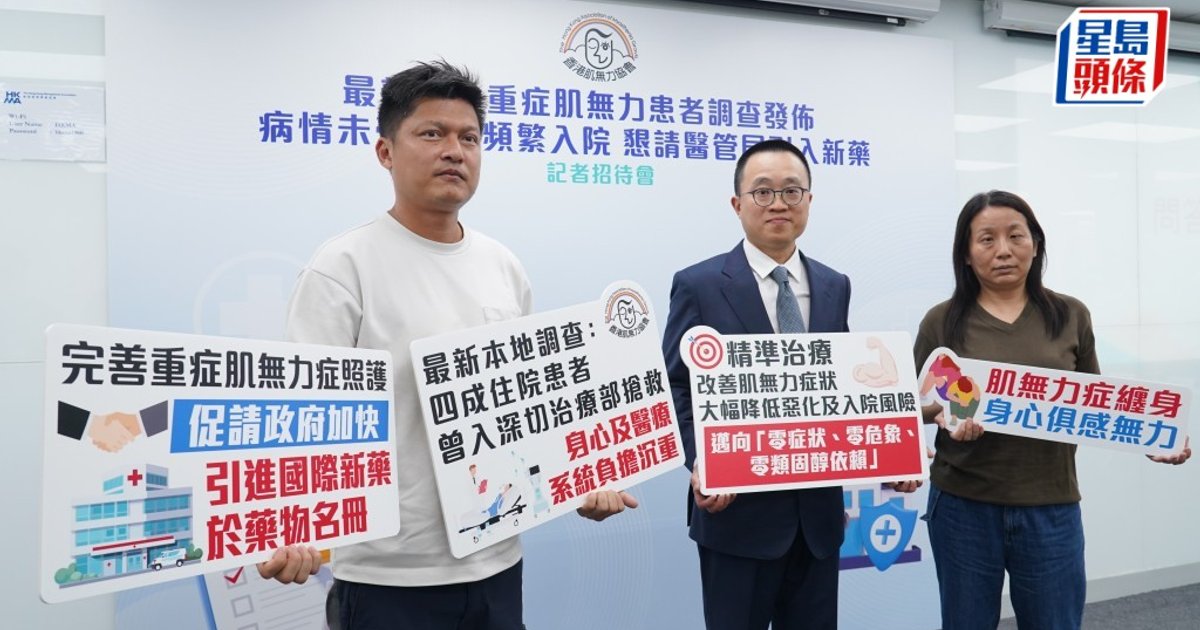
The Hong Kong Myasthenia Gravis Association has released survey findings showing that six in ten local patients on conventional treatment continue to experience uncontrolled symptoms, with over one-fifth requiring emergency care due to disease deterioration within two years. Neurologist Dr. Liu Yu-lun explains that while the autoimmune disorder primarily affects women under 40 and men over 60, a new biological drug targeting Anti-AChR antibodies has demonstrated significant efficacy, cutting exacerbation risk by nearly 80% and improving daily activity capacity more than twofold. Association chairman Cheung Siu-chung is calling on the government to include the C5 complement inhibitor in the Hospital Authority drug formulary, noting that the treatment's prohibitive cost of over HK$1 million annually places it beyond reach for most patients.
Key Points
- The association surveyed 57 local patients between April and June 2024, finding that nearly half developed symptoms before age 40, with over 30% losing work capacity and 25% experiencing depression .
- Currently, Hong Kong has approximately 1,000 to 1,500 myasthenia gravis patients, classified into ocular and generalized types, the latter accounting for about 75% of cases .
- More than 90% of surveyed patients had taken pyridostigmine (the "power pill"), and over 60% had used steroids, yet 60% still suffered from symptoms such as eyelid weakness .
- The new C5 complement inhibitor biological drug has shown in clinical studies that one-third of patients achieved near-symptom-free status, with exacerbation risk reduced by nearly 80% .
- Association chairman Cheung Siu-chung stressed that early intervention with effective medication can reduce deterioration and hospitalisation risk, urging the Hospital Authority to support patients given the small patient population .
Why It Matters
The findings underscore a significant treatment gap in Hong Kong's management of rare autoimmune diseases, where conventional therapies fail a substantial proportion of patients despite decades of use. If the C5 complement inhibitor were added to the Hospital Authority formulary, it could prevent life-threatening respiratory complications requiring intensive care while reducing long-term costs associated with emergency interventions and hospital admissions .
The findings underscore a significant treatment gap in Hong Kong's management of rare autoimmune diseases, where conventional therapies fail a substantial proportion of patients despite decades of use. If the C5 complement inhibitor were added to the Hospital Authority formulary, it could prevent life-threatening respiratory complications requiring intensive care while reducing long-term costs associated with emergency interventions and hospital admissions .