New Huanggang Port Commuters Praise Efficiency but Struggle with Cross-Border Fatigue
SingTao · 4 SOURCESabout 1 hour ago2 MIN
Summary
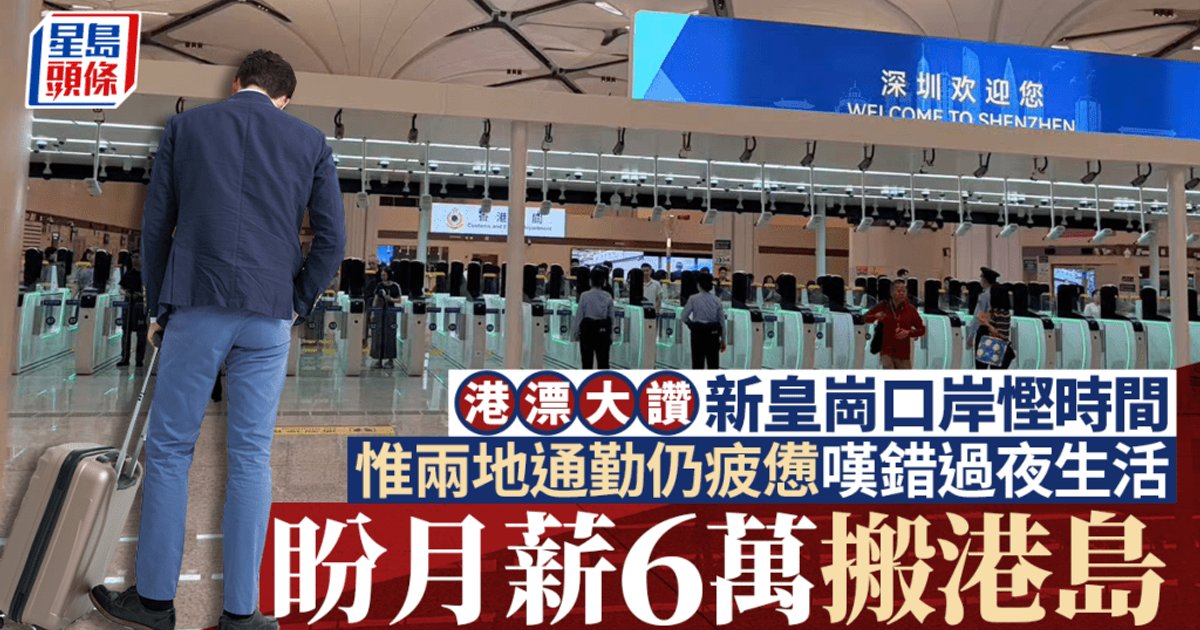
The new Huanggang Port, which officially commenced operations on October 12, has transformed cross-border commuting for thousands of Hong Kong residents working in the city while living in Shenzhen. A four-year Hong Kong immigrant identified as Ray told Sing Tao that switching to the new port saves him 15-20 minutes per journey and cuts transportation costs nearly in half. Security Bureau Chief Eddie Tang told the Legislative Council in a written reply that the port handles over 86,000 passenger crossings on weekdays—more than double the old Lok Ma Chau Control Point—and nearly 140,000 on weekends and holidays .
Key Points
- The new port features 134 cooperation inspection self-service channels and 68 traditional manual counters, with most passengers clearing customs in under 5 minutes .
- Ray commutes from his home in Shenzhen's Luohu district to his job near Harbour City, using high-speed rail in the morning and cross-border buses via the new port after work, arriving home by 7pm .
- Bus fares from Central to the port cost 45 yuan (38 yuan with Octopus), with a 20-trip monthly pass available for 550 yuan (27.5 yuan per trip), compared to 68-75 yuan for high-speed rail .
- Ray pays 6,500 yuan monthly for a 1,000+ sq ft three-bedroom apartment in Shenzhen with mountain views, versus the 8,000 yuan he previously spent on a cramped 150 sq ft unit in Hong Kong .
- Future plans include integrating the Northern Link's spur line directly into the port by 2034, enabling seamless connections between Hong Kong and Shenzhen metro networks .
Why It Matters
The new Huanggang Port represents a significant step toward Hong Kong-Shenzhen integration, with passenger volumes already exceeding expectations. However, Ray's experience highlights that improved infrastructure alone cannot resolve the fundamental tension between Hong Kong's high housing costs and commuters' desire to fully participate in local social and cultural life .
The new Huanggang Port represents a significant step toward Hong Kong-Shenzhen integration, with passenger volumes already exceeding expectations. However, Ray's experience highlights that improved infrastructure alone cannot resolve the fundamental tension between Hong Kong's high housing costs and commuters' desire to fully participate in local social and cultural life .