Paul Chan courts Cambridge ties to commercialise research
RTHK · 3 SOURCESabout 3 hours ago6 MIN
Summary
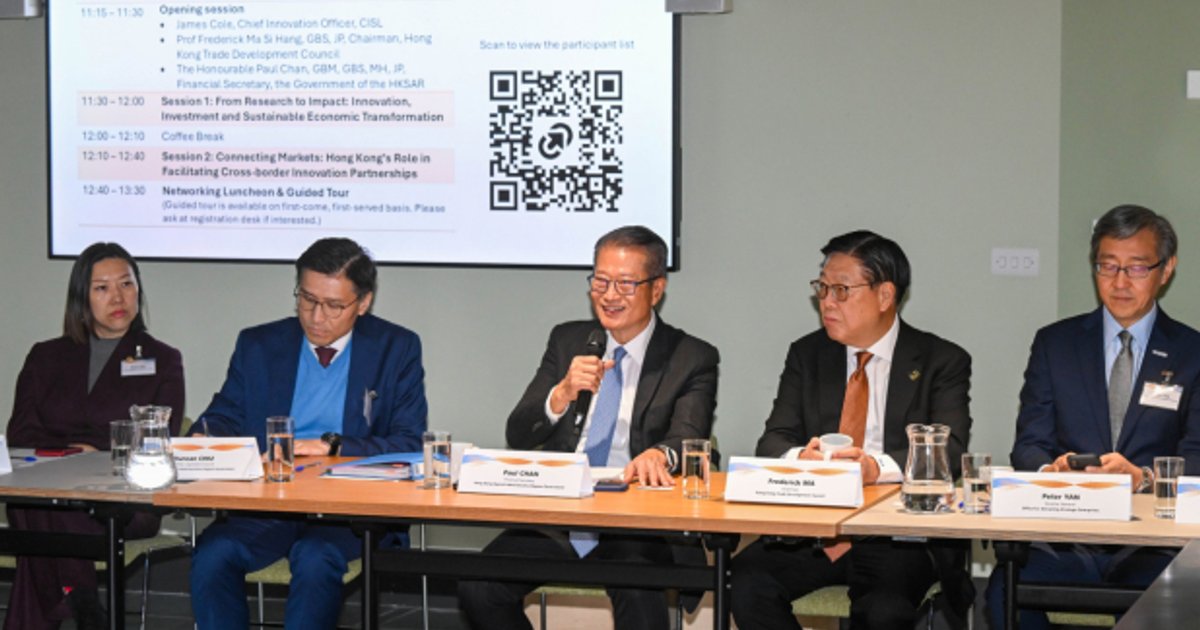
Financial Secretary Paul Chan Mo-po (陳茂波) visited Cambridge on Tuesday with a Hong Kong trade, economic and innovation delegation, meeting the University of Cambridge leadership and attending a UK-Hong Kong innovation roundtable co-organised by the Hong Kong Trade Development Council and the Cambridge Institute for Sustainability Leadership. He said Hong Kong and the UK have a strong foundation in scientific collaboration and complementary strengths, and called for closer cooperation in funding, connectivity and talent to turn research results into industries and bring them to broader markets. Chan also invited British research institutions and companies to build partnerships with the delegation, consider setting up offices or research bases in Hong Kong, and use the city’s capital markets for fundraising.
Key Points
- Chan met the vice-chancellor of the University of Cambridge to discuss stronger cooperation with Hong Kong in research, talent development and commercialisation of research outcomes.
- He briefed Cambridge on Hong Kong’s latest innovation and technology development and the planned university town in the Northern Metropolis.
- At the roundtable, Chan said more than 30 universities and research institutions worldwide have joined InnoHK joint laboratories with Hong Kong institutions, including eight from the UK
- He said the University of Cambridge is a partner in three research centres under the InnoHK innovation platform
- Chan said Hong Kong offers full-chain financing from laboratories to public markets, while the Guangdong-Hong Kong-Macao Greater Bay Area’s 88 million population provides a testing ground, production base and market for new technologies
Why It Matters
Chan’s pitch links Hong Kong’s research funding, legal system and capital markets with British science and the Greater Bay Area’s scale, aiming to position the city as a bridge for innovation between the UK and China. For Hong Kong readers, the practical consequence is whether overseas universities, biotech groups and investors choose to place research, clinical development or fundraising activity in the city rather than in competing hubs.