Hong Kong Property Market Divergence: Distressed Assets Create Opportunities
AM730 · 1 SOURCESabout 2 hours ago3 MIN
Summary
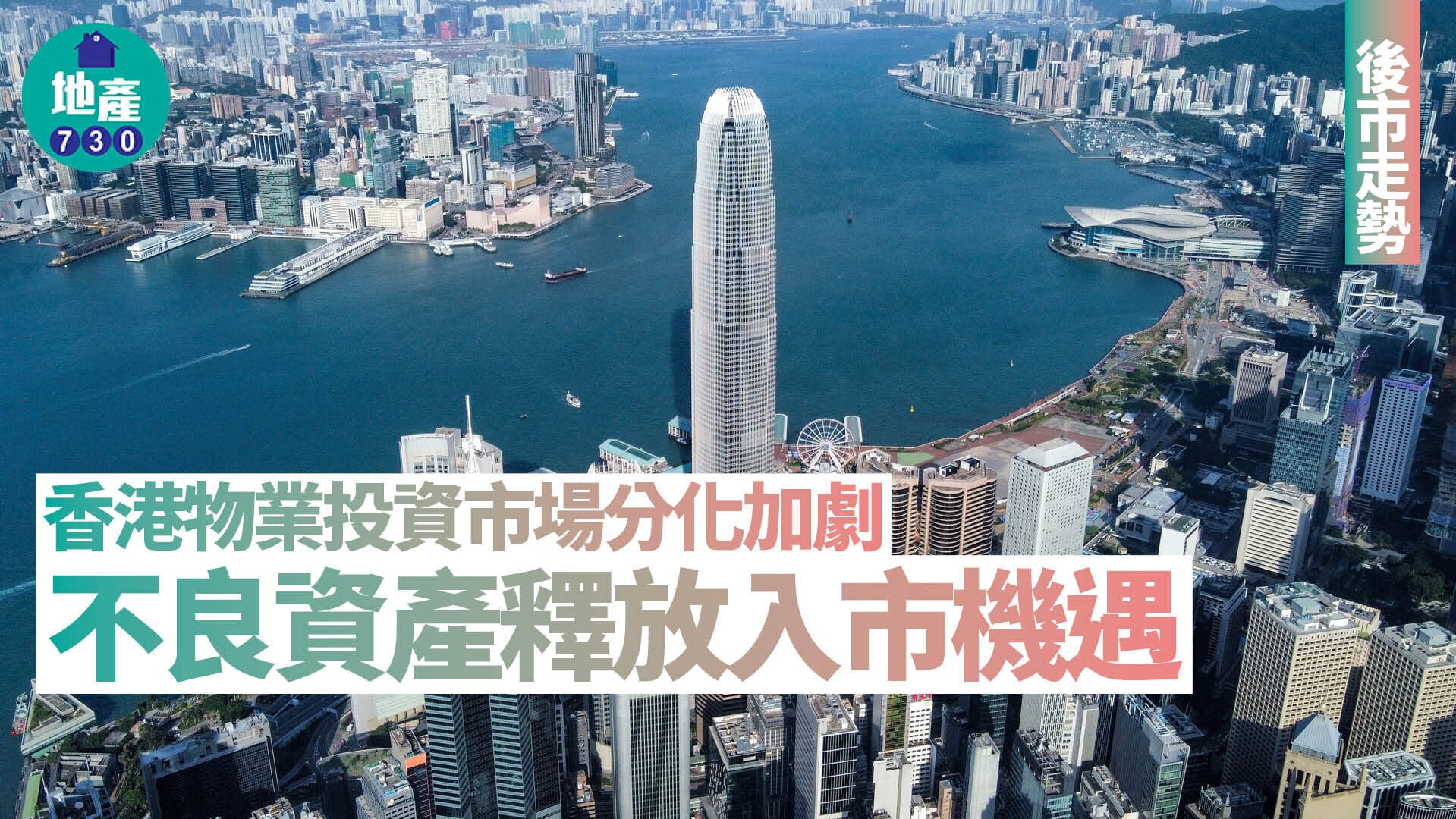
Hong Kong's property investment market is experiencing widening divergence in the second quarter of 2026, with residential segments showing resilience on mainland buyer support while commercial properties continue price adjustments. Non-residential investment surged 120% year-on-year to HK$22.3 billion in H1 2026, as capital-rich institutions and overseas investors capitalize on deeply discounted quality assets amid rising distressed supply .
Key Points
- Savills' August 2026 Investment Market Report reveals Q2 2026 market differentiation further expanding between residential and commercial sectors
- Non-residential property investment with individual transactions exceeding HK$50 million totaled HK$22.3 billion in H1 2026, representing 120% year-on-year growth; office and hotel sectors accounted for 67.6% and 21.6% respectively
- Grade A office prices have declined approximately 49% from their 2018 peak, while prime street shop prices have fallen roughly 65% from the 2013 peak; some receivership property transactions closed at 35-56% below original purchase price or valuation
- Mainland buyers contributed approximately HK$107.1 billion in residential transactions during H1 2026, roughly equivalent to 75% of the full-year 2025 volume; super luxury home transactions (over HK$100 million) reached 134 deals, up 91% year-on-year, with mainland buyers accounting for 69 transactions
- As of May 2026, hotel average daily rate recovered to 98% of the 2018 peak level; Q2 occupancy rate reached 84%; the 2024/25 academic year saw approximately 92,000 non-local students, representing a 97% increase over five years with a bed shortfall of approximately 72,000
- Q2 2026 overall Grade A office vacancy rate dropped 0.4 percentage points quarter-on-quarter to 14.8%, with office investment showing early signs of stabilization in core locations
- Savills Director of Research and Advisory Tom Cheung stated that Hong Kong's market is not short of capital, but buyers are now more rigorous regarding price and return expectations; selective recovery is expected to continue in H2 2026
- Savills Managing Director of Investment Andrew Yuen noted that office and hotel properties are attracting the most market attention, while hotel, serviced residence, and student accommodation projects with conversion potential continue drawing long-term capital
Why It Matters
The emerging selective recovery pattern suggests Hong Kong's property market is transitioning from a broad downturn toward a quality-driven consolidation phase, where well-capitalized investors are positioned to acquire distressed assets at significant discounts. The concentration of capital in core assets with stable cash flows may reshape competitive dynamics in the commercial property sector, particularly as mainland buyers demonstrate sustained appetite across both residential and investment-grade segments .
The emerging selective recovery pattern suggests Hong Kong's property market is transitioning from a broad downturn toward a quality-driven consolidation phase, where well-capitalized investors are positioned to acquire distressed assets at significant discounts. The concentration of capital in core assets with stable cash flows may reshape competitive dynamics in the commercial property sector, particularly as mainland buyers demonstrate sustained appetite across both residential and investment-grade segments .