Five Guys Kwun Tong APM Store Closes as Brand Shrinks Hong Kong Presence
SingTao · 2 SOURCES1 day ago2 MIN
Summary
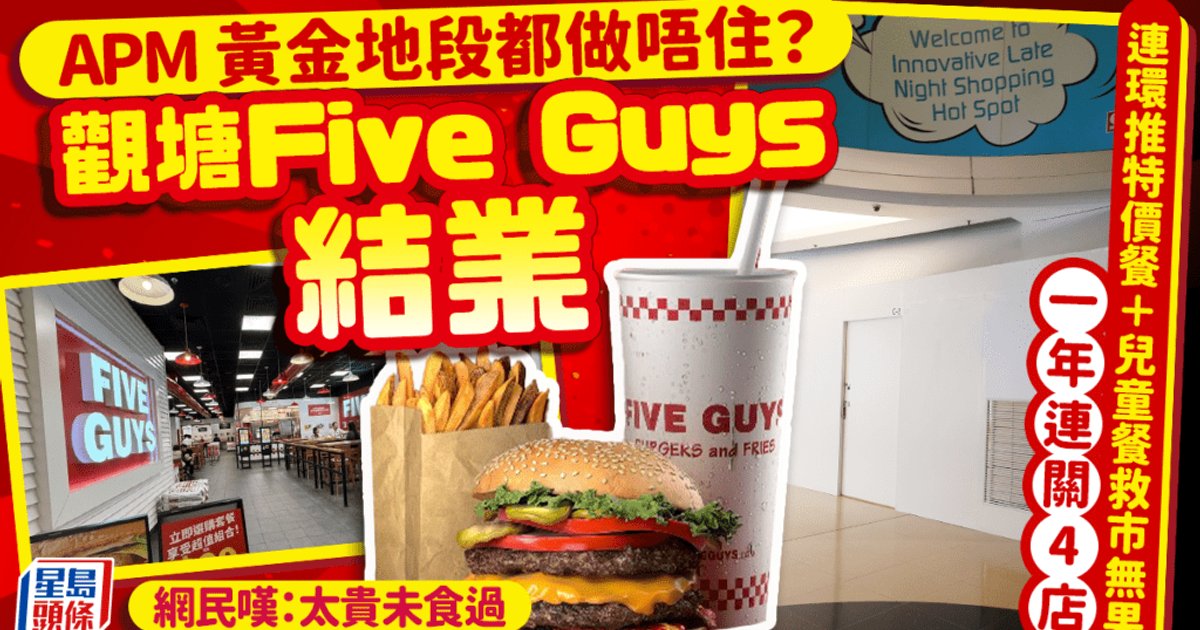
Five Guys has shuttered its Kwun Tong APM branch, the fourth Hong Kong location to close within a year, as the American burger chain continues to scale back its citywide presence. The closure of this prime-location outlet near the MTR station entrance highlights the challenges facing premium-priced quick-service brands in a competitive local market. Despite introducing value-oriented meals and a historic children's menu, the chain appears unable to overcome consumer objections to its pricing.
Key Points
- The Kwun Tong APM store was recently surrounded by white boards, and Five Guys' official website has removed the location from its store list
- This departure brings the total closures to four locations over one year, including North Point (late last year), Tsuen Wan Citywalk, and Causeway Bay Russell Street
- Five Guys now operates just five remaining branches: Tsim Sha Tsui K11 MUSEA, Wan Chai Johnston Road, Kowloon Tong Festival Walk, Central Melburn Place, and Olympic Olympia
- The brand entered Hong Kong in 2018 and built its reputation on made-to-order burgers, hand-cut fries, and customizable milkshakes
- Responding to market pressure, Five Guys launched a $99 set meal last year and subsequently introduced an $80 children's meal, its first in 40 years of operation
Why It Matters
The closure of a flagship location in a high-traffic transit hub underscores the difficulties premium fast-food brands face adapting to Hong Kong's cost-conscious dining culture, where consumers expect value-oriented options from quick-service establishments. This contraction signals potential recalibration strategies for international casual dining brands entering or operating in the Hong Kong market.
The closure of a flagship location in a high-traffic transit hub underscores the difficulties premium fast-food brands face adapting to Hong Kong's cost-conscious dining culture, where consumers expect value-oriented options from quick-service establishments. This contraction signals potential recalibration strategies for international casual dining brands entering or operating in the Hong Kong market.