HKU completes Asia’s first histotripsy kidney cancer cases
HK01 · 4 SOURCESabout 5 hours ago6 MIN
Summary
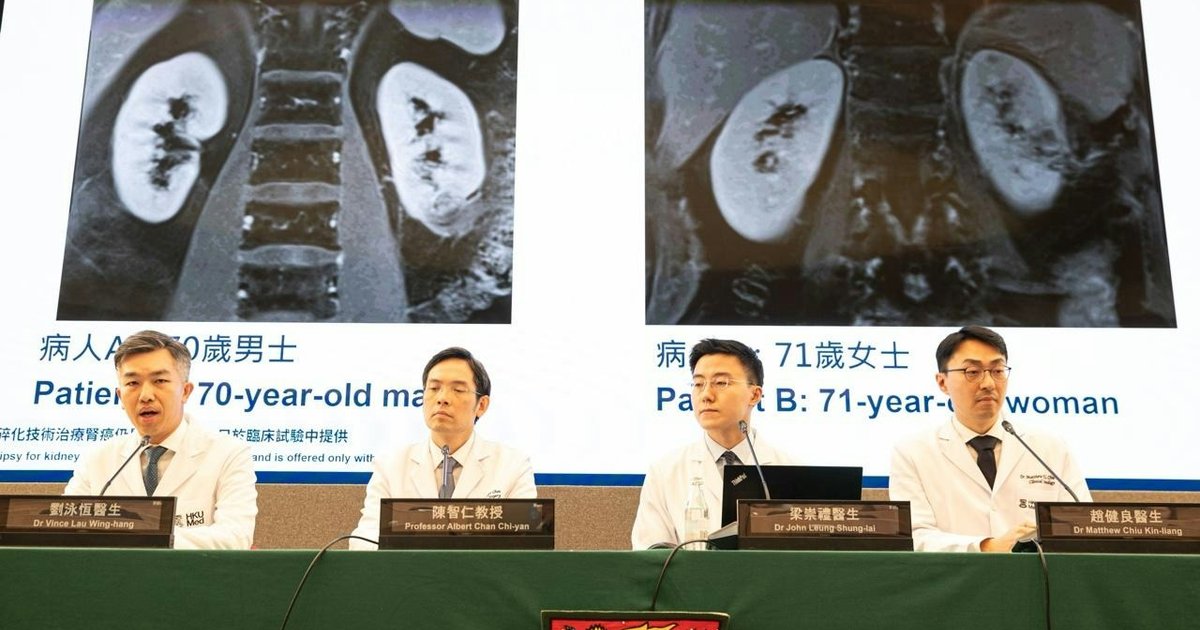
The University of Hong Kong’s Li Ka Shing Faculty of Medicine said it has completed Asia’s first two cases of using histotripsy to treat early-stage kidney cancer, in collaboration with Gleneagles Hospital Hong Kong. The non-invasive procedure uses focused ultrasound from outside the body to create a bubble cloud inside the tumour, liquefying and destroying tumour tissue without incisions, radiation or heat. The two patients, a 70-year-old man and a 71-year-old woman, both completed treatment in about one hour, were discharged the next day and had stable conditions without observed complications on follow-up. The team said the treatment is currently suitable only for early kidney cancer in the clinical stage and is recruiting 15 patients with early localized renal cell carcinoma for further study.
Key Points
- HKU said current kidney cancer options mainly include active surveillance, surgery, ablation and drug treatment, with histotripsy being explored as an additional non-invasive option
- According to Clinical Professor Chan Chi-yan (陳智仁), doctors direct ultrasound energy precisely at the renal tumour, and each procedure takes about one hour.
- HKU said it first introduced the technology for liver cancer in 2024, later expanded to pancreatic cancer, and has completed about 20 pancreatic cancer cases.
- Clinical Assistant Professor Leung Chung-lai (梁崇禮) said the main side effect so far is blood in the urine, which usually subsides within one to two days.
- Honorary Clinical Associate Professor Lau Wing-hang (劉泳恆) said general anaesthesia is used so the device can focus accurately, and one-month checks showed the treated area shrinking gradually
Why It Matters
For Hong Kong patients who are older, have had major surgery before, or are reluctant to undergo conventional operations, histotripsy could widen treatment choices if clinical results continue to hold up. The work also extends a technology HKU has already applied to liver and pancreatic cancers, suggesting a broader local research platform for combining non-invasive tumour treatment with other therapies in future.