PISA 2025: Hong Kong Students' Performance Declines Since 2012 Peak, Scholars Urge Reform
SingTao · 1 SOURCES1 day ago5 MIN
Summary
The University of Hong Kong's Faculty of Education published the PISA 2025 results in early September 2026, revealing a concerning downward trend in Hong Kong students' performance across science, mathematics, and reading since the 2012 peak. The proportion of students achieving high-level mathematics performance fell dramatically from 33.7% in 2012 to 20.7% in 2025, while roughly 20% of students do not meet basic proficiency standards in science and reading. Despite these declines, Hong Kong students demonstrated strength in "Learning in a Digital World," scoring 545 points and showing advantages in programming, modelling, and computational problem-solving. A seminar attended by approximately 200 people was held last month to analyze the findings and propose educational reforms.
Key Points
- HKU's Faculty of Education released PISA 2025 results in early September, showing Hong Kong students' overall performance in science, mathematics, and reading has declined since the 2012 peak .
- The proportion of high-performing mathematics students dropped from 33.7% in 2012 to 20.7% in 2025, while approximately 20% of students lack basic proficiency in science and reading .
- Hong Kong students scored 545 points in "Learning in a Digital World," demonstrating strengths in programming, modelling, and computational problem-solving .
- Professor Law Luk Wai-ying (羅陸慧英) suggested that students' digital learning advantages could serve as a bridge to connect science, mathematics, and reading instruction .
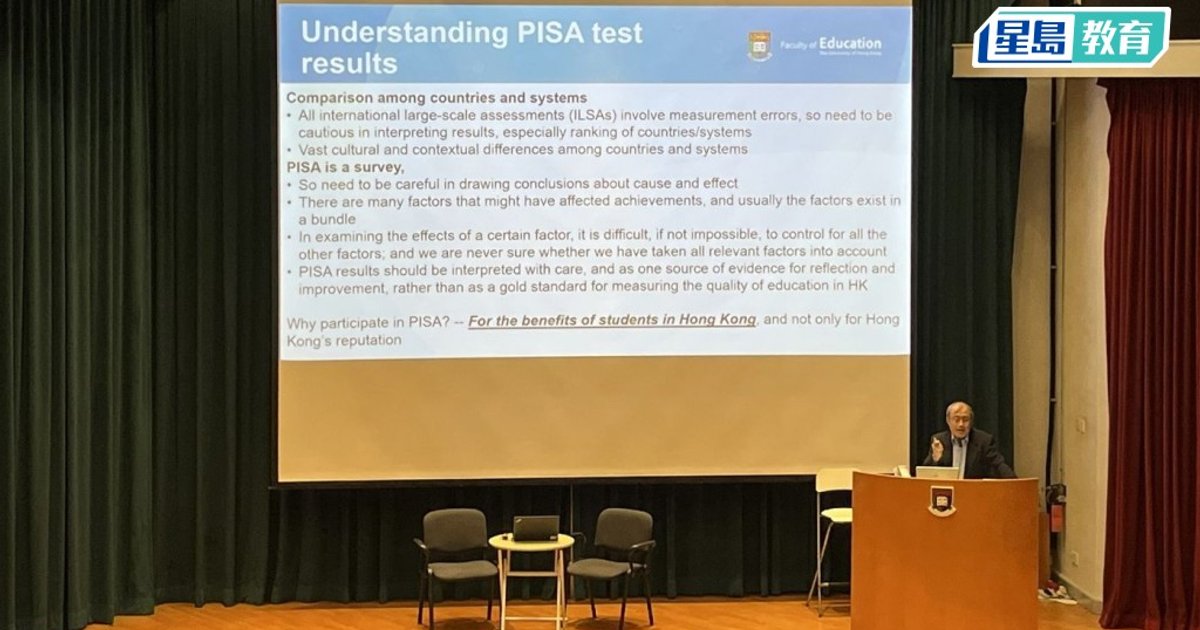
- Professor Leung Koon-shing (梁貫成) emphasized that PISA should be viewed as an educational "health check" rather than a complete report card, with its value lying in inspiring improvement .
Why It Matters
The declining PISA results signal an urgent need for Hong Kong's education system to shift from test-oriented teaching toward cultivating students' ability to face and shape an uncertain future. Scholars pointed to Singapore's example of maintaining academic excellence while reducing excessive competition and exam pressure, suggesting that student well-being and academic performance need not be mutually exclusive.
The declining PISA results signal an urgent need for Hong Kong's education system to shift from test-oriented teaching toward cultivating students' ability to face and shape an uncertain future. Scholars pointed to Singapore's example of maintaining academic excellence while reducing excessive competition and exam pressure, suggesting that student well-being and academic performance need not be mutually exclusive.