Our Hong Kong Foundation Proposes 'Value Port' Strategy to Boost Maritime Services
SingTao · 2 SOURCESabout 18 hours ago3 MIN
Summary
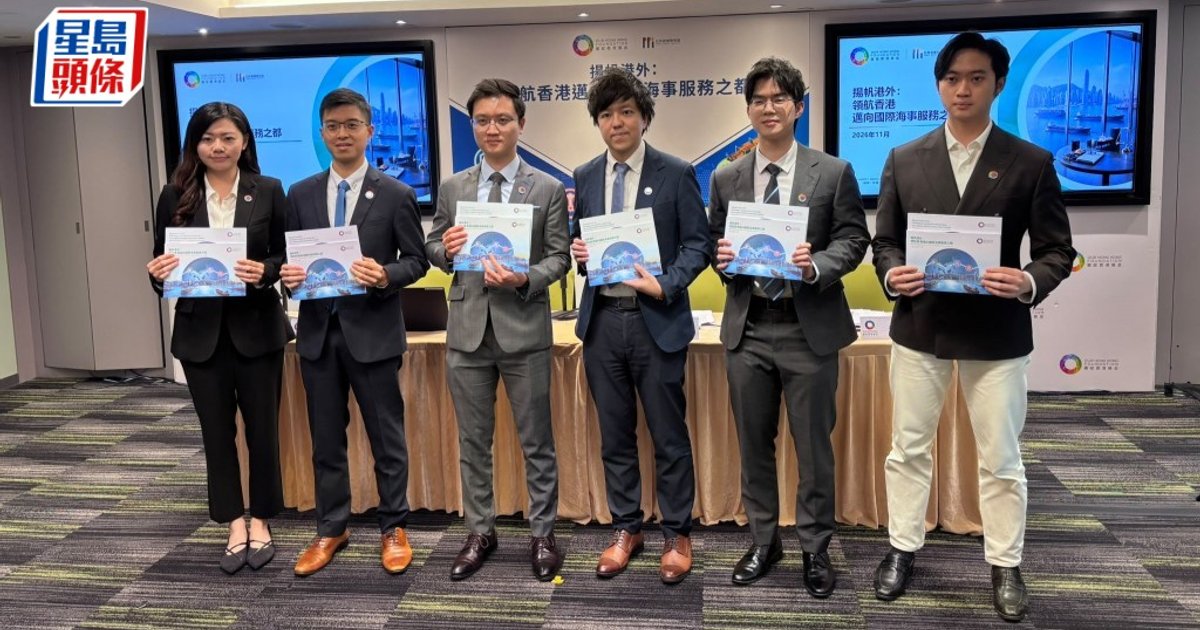
Our Hong Kong Foundation released its policy research report titled "Beyond the Sails: Steering Hong Kong Towards an International Maritime Services Capital" on Tuesday . The report recommends Hong Kong transition from a traditional "tonnage port" to a "value port" centred on knowledge-based and professional services . The foundation proposes 10 policy measures across four high-value pillars: commodity trading, marine insurance, ship leasing, and maritime arbitration . These four areas are interconnected, linking physical trade with financial, risk management, and legal services that sustain maritime commerce . The report notes that while container cargo accounts for only 15% of global shipping by tonnage, the remaining 85% consists mainly of bulk commodities and raw materials .
Key Points
- Hong Kong currently hosts only 40-plus commodity traders, far fewer than Singapore's 400-plus and Switzerland's 900-plus, indicating significant growth potential
- The report proposes a two-tier tax mechanism for commodity trading, with an entry-level 8.25% rate for smaller traders who do not meet the HKD 700 million annual revenue threshold
- Singapore hosts approximately 90 captive insurers out of over 6,000 globally, while Hong Kong has only 9, largely due to current restrictions allowing only single-parent structures
- The report recommends shifting Hong Kong's tax system from entity-based to activity-based to counter the erosion of its 0% profit tax advantage under BEPS 2.0 global minimum tax rules
- Shui Chi-wai, Vice President and Executive Director of the Public Policy Institute, concluded that the report aims to translate policy direction into actionable measures
Why It Matters
The report arrives at a critical juncture as China's 15th Five-Year Plan and Hong Kong's first Five-Year Plan both support developing commodity trading and high-value maritime services ecosystems . By positioning Hong Kong as a "value port" rather than competing solely on cargo volumes, the city can leverage its institutional advantages—including common law, free capital flow, and internationally aligned financial markets—to capture higher-margin maritime business . Currently, maritime and professional services contribute four times more to the local economy than port-related industries . The interconnected nature of the four pillars means that strengthening one area, such as commodity trading, would cascade through the ecosystem, boosting demand for financing, insurance, and legal services .
The report arrives at a critical juncture as China's 15th Five-Year Plan and Hong Kong's first Five-Year Plan both support developing commodity trading and high-value maritime services ecosystems . By positioning Hong Kong as a "value port" rather than competing solely on cargo volumes, the city can leverage its institutional advantages—including common law, free capital flow, and internationally aligned financial markets—to capture higher-margin maritime business . Currently, maritime and professional services contribute four times more to the local economy than port-related industries . The interconnected nature of the four pillars means that strengthening one area, such as commodity trading, would cascade through the ecosystem, boosting demand for financing, insurance, and legal services .