SF Express, OFCA Team Up to Combat Scams With App-Only Notifications
HK01 · 2 SOURCES1 day ago6 MIN
Summary
SF Express Hong Kong has replaced SMS notifications with its official mobile application, dramatically reducing customer fraud rates from 5.03% to 0.65% since 2025. The Communications Authority (OFCA) has enrolled more than 880 companies and organizations in its Sender ID Registry, where verified businesses display a # prefix that allows both identification and automatic network blocking of fraudulent messages.
Key Points
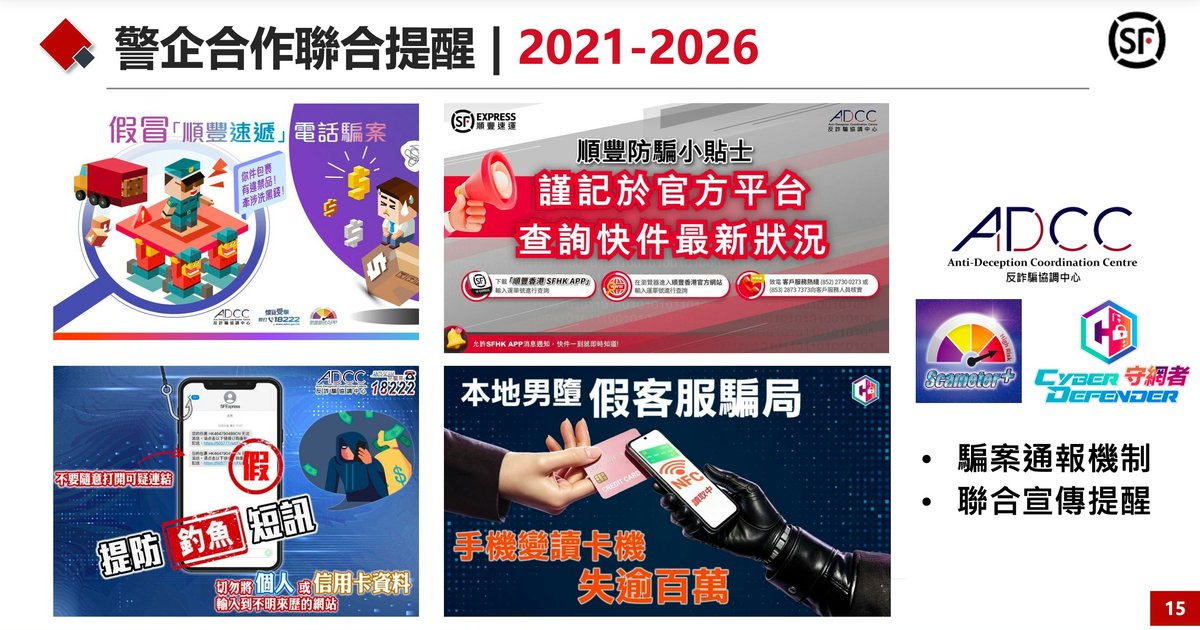
- SF Express Hong Kong public affairs head Qin Yuying (秦玉英) confirmed the company switched to app-only communications in 2025, eliminating traditional SMS as an attack vector
- Customer fraud rate plummeted from 5.03% to 0.65% after transitioning to the official SFHK App, which offers real-time parcel tracking and 24-hour online customer service
- OFCA's Sender ID Registry launched on October 28, 2023, and grown to over 880 participating companies including telecom providers, banks, and government departments by August 2026
- OFCA Chief Regulatory Manager Chan Kin-leung (陳建良) stated that networks automatically block messages with a # prefix unless confirmed as legitimately registered
- SF Express enforces a "Three No's" anti-fraud policy: it never requests personal information, never demands bank transfers, and never transfers calls to law enforcement or financial institutions
- Hong Kong Police Commissioner Zhou Yiming revealed that fake customer service calls account for 80% of phone fraud cases, with many appearing to originate from local numbers
- Telecom operators blocked 1,500 fraudulent sender IDs between January and August 2026 through coordinated efforts with OFCA
- The # prefix identifier consists of 3 to 10 characters using uppercase/lowercase English letters, numbers, or special symbols; Chinese characters are not supported
Why It Matters
These coordinated measures address a critical vulnerability in Hong Kong's communications ecosystem: fraudsters routinely impersonate legitimate businesses using spoofed SMS sender names. By shifting customers to authenticated app channels and deploying network-level filtering based on verified sender IDs, the authorities are fundamentally redesigning the trust infrastructure of mobile messaging. The public can now verify registered senders through OFCA's online registry, creating a verifiable chain of authenticity for commercial short messages.
These coordinated measures address a critical vulnerability in Hong Kong's communications ecosystem: fraudsters routinely impersonate legitimate businesses using spoofed SMS sender names. By shifting customers to authenticated app channels and deploying network-level filtering based on verified sender IDs, the authorities are fundamentally redesigning the trust infrastructure of mobile messaging. The public can now verify registered senders through OFCA's online registry, creating a verifiable chain of authenticity for commercial short messages.