NASA's Hubble Captures 'Cosmic Smile' Revealing Space-Time Distortion
Bastillepost · 2 SOURCES1 day ago2 MIN
Summary
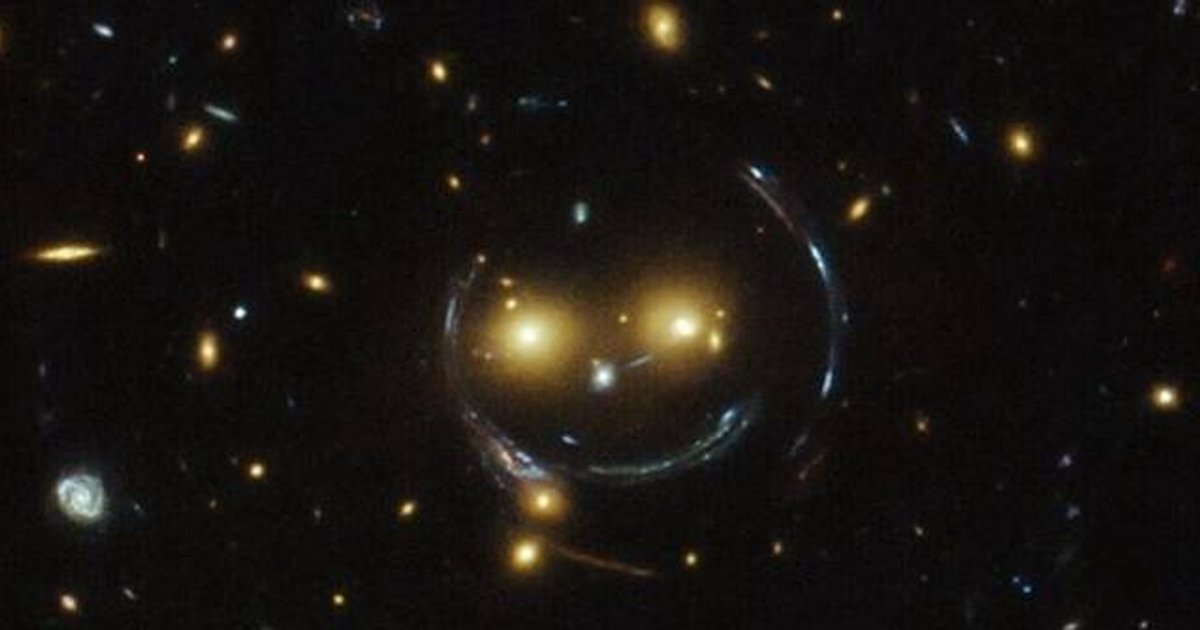
NASA has released a stunning Hubble Space Telescope image showing a 'cosmic smile' created by a phenomenon called strong gravitational lensing. The galaxy cluster SDSS J1038+4849, originally photographed in 2015, was reshared on social media on October 12, generating renewed public fascination. The optical illusion occurs when massive foreground objects bend light from distant background galaxies, creating arc-like distortions that resemble a smiling face. This cosmic phenomenon offers astronomers a natural magnifying glass to study previously unobservable celestial objects and map the distribution of dark matter within galaxy clusters.
Key Points
- The galaxy cluster designated SDSS J1038+4849 was first captured by Hubble in 2015, with NASA reposting the image on October 12
- The two bright 'eyes' in the image are actually extremely luminous galaxies, while the 'smile' consists of curved light from a background galaxy distorted by gravity
- Massive celestial objects bend the fabric of spacetime around them, functioning as a 'cosmic lens' that magnifies and distorts distant light sources
- Gravitational lensing enables scientists to observe faraway galaxies and faint celestial bodies that would otherwise be impossible to photograph directly
- Researchers can map dark matter distribution within galaxy clusters by precisely measuring how background light is warped and bent
Why It Matters
The cosmic smile illustrates one of Einstein's predictions about general relativity—that massive objects curve spacetime and bend light. This gravitational lensing effect serves as a natural telescope, allowing astronomers to peer deeper into the universe and investigate the mysterious dark matter that constitutes approximately 27% of the universe's mass-energy content . For Hong Kong's growing astronomy community and science enthusiasts, this image demonstrates how fundamental physics principles continue to unlock the secrets of the cosmos.
The cosmic smile illustrates one of Einstein's predictions about general relativity—that massive objects curve spacetime and bend light. This gravitational lensing effect serves as a natural telescope, allowing astronomers to peer deeper into the universe and investigate the mysterious dark matter that constitutes approximately 27% of the universe's mass-energy content . For Hong Kong's growing astronomy community and science enthusiasts, this image demonstrates how fundamental physics principles continue to unlock the secrets of the cosmos.