CUHK AI Retinal Screening Identifies Cognitive Impairment Risk, Expanding to Wong Tai Sin in January
HK01 · 6 SOURCES1 day ago7 MIN
Summary
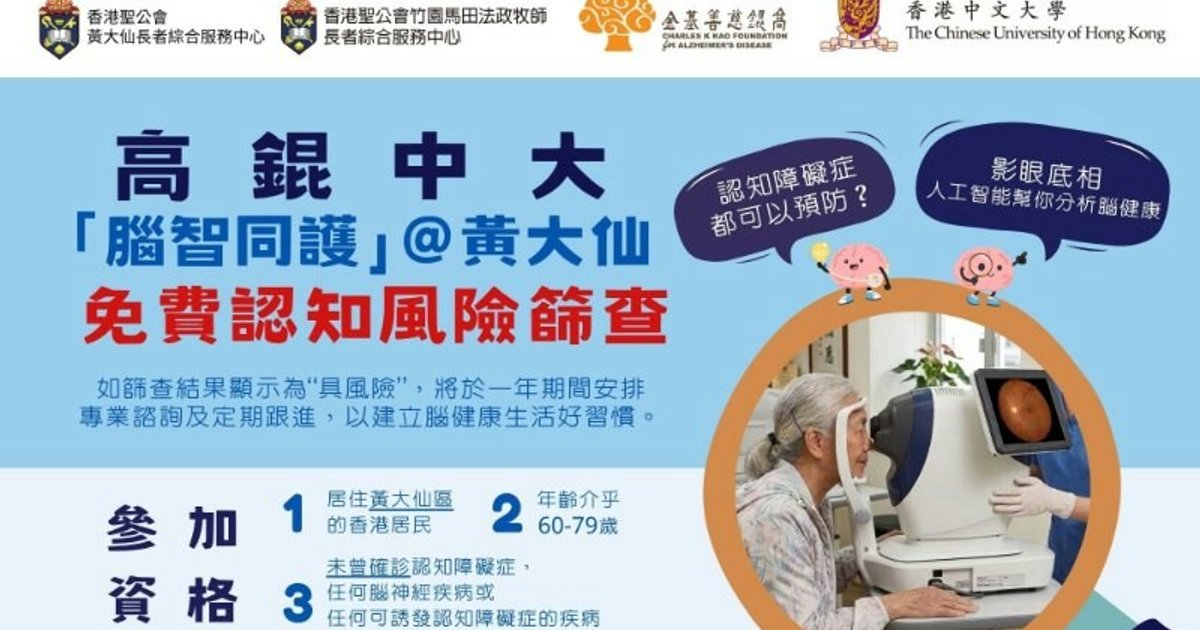
The Chinese University of Hong Kong (CUHK) Faculty of Medicine, in collaboration with the Charles K. Kao Foundation for Alzheimer's Disease, has developed an AI-powered retinal imaging technology that can identify individuals at higher risk of cognitive impairment before symptoms appear. The "Brain Care Together" (腦智同護) service program, launched as a pilot in October 2023, has analyzed retinal photos from 831 cognitively normal community participants, finding that approximately 21% tested positive on the AI screening and showed poorer cognitive function performance. A one-year follow-up of 532 participants demonstrated significant improvements: those who received personalized brain health management improved their brain health scores by an average of 1.3 points, compared to just 0.2 points for the control group receiving only general brain health education. These participants' cognitive assessment scores became comparable to those of individuals approximately three years younger, effectively achieving "cognitive rejuvenation." The program will expand to Wong Tai Sin district in January 2026, partnering with the Hong Kong Sheng Kung Hui Welfare Association to provide free brain health assessments for 2,700 elderly residents aged 60 to 79 over two years.
Key Points
- The AI retinal imaging technology, developed by CUHK researchers, analyzes retinal photographs to identify cognitively normal individuals who may face elevated Alzheimer's disease risk, with about 21% of 831 participants screening positive .
- One-year follow-up data from 532 participants showed that personalized brain health management improved brain health scores by 1.3 points on average, versus 0.2 points for the education-only control group .
- Participants receiving personalized management achieved cognitive assessment scores comparable to individuals approximately three years younger, demonstrating measurable "cognitive rejuvenation" effects .
- The program will launch in Wong Tai Sin in January 2026, targeting 2,700 residents aged 60 to 79 who have not been diagnosed with cognitive impairment or related neurological conditions .
- Hong Kong currently has approximately 180,000 dementia patients, projected to rise to 240,000 by 2036, with 50% of those aged 85 and above affected .
Why It Matters
This AI-powered screening technology represents a paradigm shift toward preventive cognitive healthcare, addressing Hong Kong's rapidly aging population and the looming dementia crisis. With over 45% of cognitive impairment cases being preventable or delayable through management of modifiable risk factors such as hypertension, diabetes, and lifestyle choices, early identification through retinal imaging could significantly reduce the societal and economic burden of dementia while improving quality of life for elderly residents .
This AI-powered screening technology represents a paradigm shift toward preventive cognitive healthcare, addressing Hong Kong's rapidly aging population and the looming dementia crisis. With over 45% of cognitive impairment cases being preventable or delayable through management of modifiable risk factors such as hypertension, diabetes, and lifestyle choices, early identification through retinal imaging could significantly reduce the societal and economic burden of dementia while improving quality of life for elderly residents .