13-Year-Old Shanghai Student Creates AI Study Companion, Earns HK$20,000 in 3-Day Competition
SingTao · 1 SOURCESabout 2 hours ago6 MIN
Summary
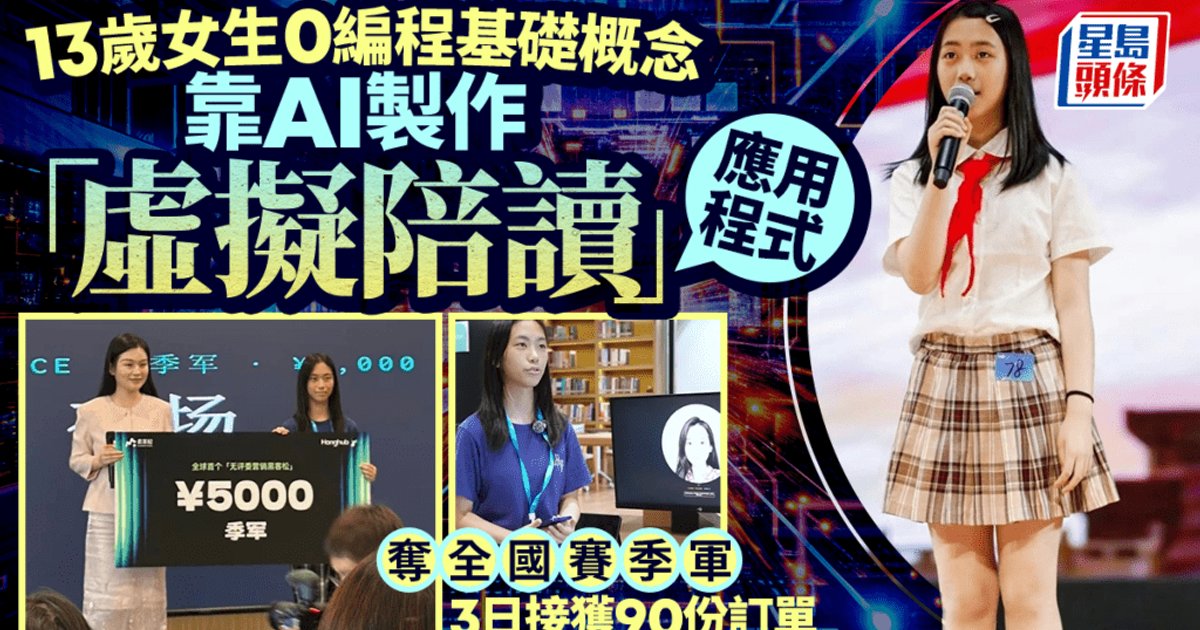
In a remarkable demonstration of how generative AI has democratized software development, a 13-year-old Shanghai student with zero programming experience has created a fully functional AI application that generated significant revenue within days. Zhu Shuhan, a second-year middle school student at Shanghai Kaiyuan School, leveraged natural language prompts to develop "Zai Chang" (Being Present), a virtual study companion app that won third place at a major hackathon in Hangzhou, earning her over 18,000 yuan (approximately HK$20,000) in just three days.
Key Points
- Zhu Shuhan, 13, a second-year student at Shanghai Kaiyuan School, developed the AI app using only natural language prompts without any programming knowledge
- The app "Zai Chang" (Being Present) functions as a "virtual parent分身" by generating avatar versions of parents from uploaded photos
- When the computer or phone camera detects students playing with phones, sleeping at their desks, or leaving their seats, the virtual parent avatar issues voice reminders
- The system notifies real parents after a certain number of warnings and generates a concentration analysis report after each study session
- Zhu participated in the Judgeless Marketing Hackathon (Markethon) in Hangzhou, where 50-plus teams competed over 48 hours with no judges—only real paying users as judges
- She sold nearly 90 orders in three days, earning net revenue exceeding 18,000 yuan (approximately HK$20,000), securing third place
- Zhu began self-studying AI just one year ago, and the app's gentle reminder tone was deliberately designed to maintain appropriate boundaries for peers
Why It Matters
This case highlights how AI is fundamentally transforming education by dramatically lowering technical barriers, shifting the focus from memorizing code to cultivating observational skills and problem-solving abilities. For Hong Kong students and educators, this signals an impending paradigm shift in how technology should be integrated into learning—prioritizing creativity and practical application over traditional rote learning, potentially reshaping local STEM education curricula and competitive dynamics in the region.
This case highlights how AI is fundamentally transforming education by dramatically lowering technical barriers, shifting the focus from memorizing code to cultivating observational skills and problem-solving abilities. For Hong Kong students and educators, this signals an impending paradigm shift in how technology should be integrated into learning—prioritizing creativity and practical application over traditional rote learning, potentially reshaping local STEM education curricula and competitive dynamics in the region.