G20 Foreign Ministers Fail to Issue Joint Communiqué as Geopolitical Tensions Escalate
Crhk · 5 SOURCES1 day ago3 MIN
Summary
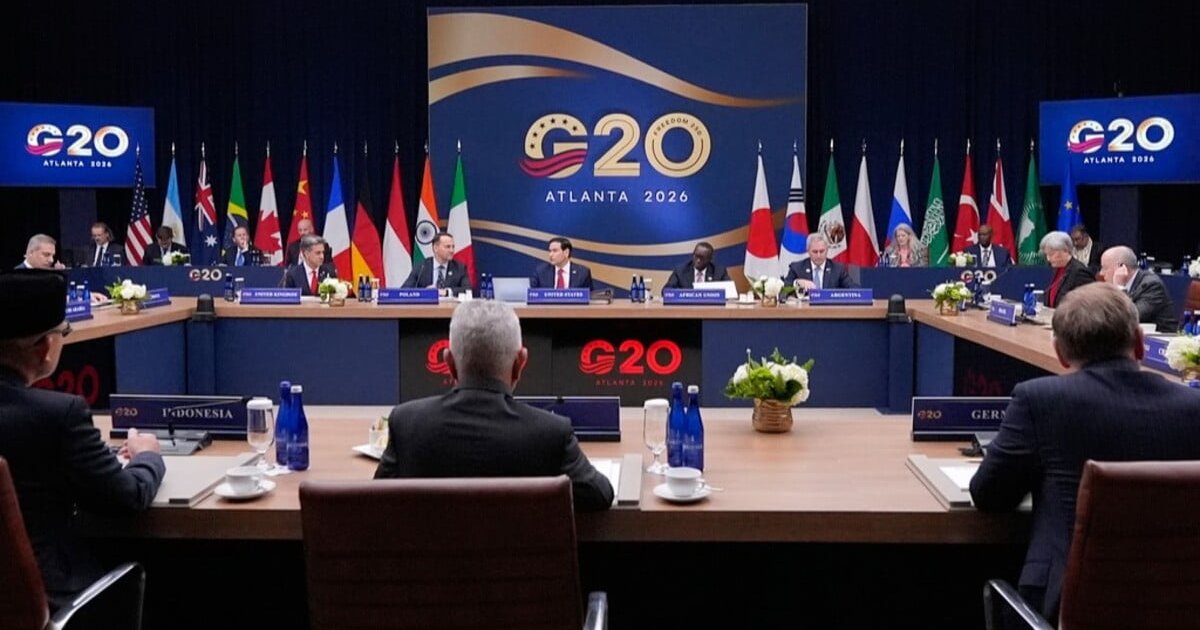
The two-day G20 foreign ministers meeting in Atlanta concluded on Saturday without issuing a joint communiqué after member states failed to reach consensus on multiple critical global issues. US Secretary of State Marco Rubio, serving as the host, released a chair's statement outlining priority areas including energy security, food security, and freedom of navigation . Tensions were evident from the start when several Western nations boycotted the traditional group photo in protest of Russian Foreign Minister Sergei Lavrov's attendance, prompting the cancellation of the photo session . Chinese Vice Foreign Minister Ma Zhaoxu attended the meeting and urged the G20 to shoulder its responsibilities in maintaining world peace and stability amid an international landscape marked by turbulence and transformation .
Key Points
- The G20 foreign ministers meeting in Atlanta concluded without a joint communiqué, with Rubio issuing a chair's statement covering energy security, food security, and freedom of navigation
- Multiple European nations, Canada, and Australia boycotted the group photo due to Lavrov's presence, leading to its cancellation
- Rubio defended inviting Lavrov, stating that dialogue is necessary to end conflicts through diplomatic means, while noting Turkey and India's ceasefire proposal for Black Sea shipping safety
- The Quad (US, Japan, Australia, India) held bilateral talks and issued a joint statement criticizing non-market policies and economic coercion, targeting China's dominance in rare earths
- Rubio indicated that bilateral meetings between US, China, and Russia leaders are expected at upcoming APEC and G20 summits, including discussions on a potential Trump-Putin meeting
- Trump is considering inviting Ukrainian President Zelensky to the December G20 summit in Miami, while Putin's attendance remains unconfirmed
- Ma Zhaoxu warned against protectionism and decoupling, emphasizing the need to maintain stable global supply chains and avoid politicizing trade issues
Why It Matters
The failure to reach consensus on a joint communiqué underscores the deepening geopolitical divisions among major powers, with the Ukraine crisis and US-Iran tensions casting a long shadow over multilateral cooperation . For Hong Kong, which depends on stable international supply chains and serves as a crucial link between China and Western markets, these fault lines pose direct economic risks as trade frameworks become increasingly fragmented . The absence of a unified G20 response also signals growing challenges for diplomatic solutions to global conflicts, potentially reshaping the international order that underpins Hong Kong's status as a global financial centre.
The failure to reach consensus on a joint communiqué underscores the deepening geopolitical divisions among major powers, with the Ukraine crisis and US-Iran tensions casting a long shadow over multilateral cooperation . For Hong Kong, which depends on stable international supply chains and serves as a crucial link between China and Western markets, these fault lines pose direct economic risks as trade frameworks become increasingly fragmented . The absence of a unified G20 response also signals growing challenges for diplomatic solutions to global conflicts, potentially reshaping the international order that underpins Hong Kong's status as a global financial centre.