Home Robots Expected to Become Household Standard Within Decade
SingTao · 1 SOURCESabout 2 hours ago6 MIN
Summary
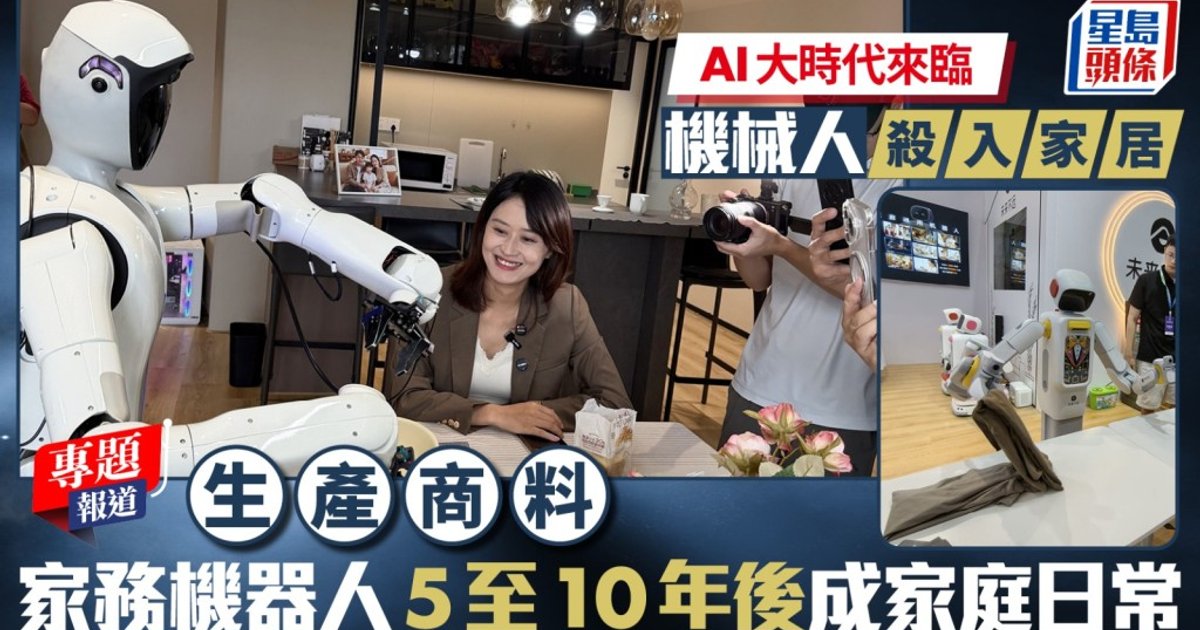
The race to develop household humanoid robots is accelerating, with Chinese and American companies investing heavily in technology that could fundamentally transform domestic life. Vision Plus (极佳视界), a Chinese AI company, has launched Shiguang S1 (拾光S1), described as China's first general-purpose humanoid robot for home scenarios, in Wuhan's Guanggu district in May 2026. Industry executives and technology experts interviewed by Sing Tao Daily predict that within five to ten years, such robots will become affordable enough for ordinary families, potentially replacing foreign domestic helpers and serving as companions for Hong Kong's growing elderly population.
Key Points
- Vision Plus Sales Vice President Wang Jinshan (王金山) stated that current home robots priced at 300,000 to 500,000 yuan are expected to drop below 100,000 yuan within the next decade as production scales up
- The company anticipates a "physical AI GPT moment" in approximately two years, when robots can complete over 90 percent of basic household tasks autonomously upon unboxing
- Hong Kong Legislative Council member Wong Wing-wai (黃永威) noted that local elderly prefer aging at home, creating strong demand for companion robots that can provide personalized nursing care
- Hong Kong Information Technology Association Honorary President Francis Fong Po-kyu (方保僑) predicted that humanoid robots could replace foreign domestic helpers and work in elderly care homes within three to five years
- Elon Musk told The Economist in July that AI could surpass human intelligence within five years and robots could take over most jobs within ten years
Why It Matters
Hong Kong's combination of an aging population, high density living, and widespread reliance on foreign domestic helpers makes it a prime market for household robots. As technology matures and prices decline, robots could address critical labor shortages in elder care while transforming how Hong Kong families manage domestic responsibilities. The development also presents opportunities for Hong Kong companies to specialize in training and designing elder care robots for export to aging societies in Japan, South Korea, and beyond .
Hong Kong's combination of an aging population, high density living, and widespread reliance on foreign domestic helpers makes it a prime market for household robots. As technology matures and prices decline, robots could address critical labor shortages in elder care while transforming how Hong Kong families manage domestic responsibilities. The development also presents opportunities for Hong Kong companies to specialize in training and designing elder care robots for export to aging societies in Japan, South Korea, and beyond .