China Achieves First Land-Based Recovery of Reusable Rocket
AM730 · 5 SOURCESabout 3 hours ago2 MIN
Summary
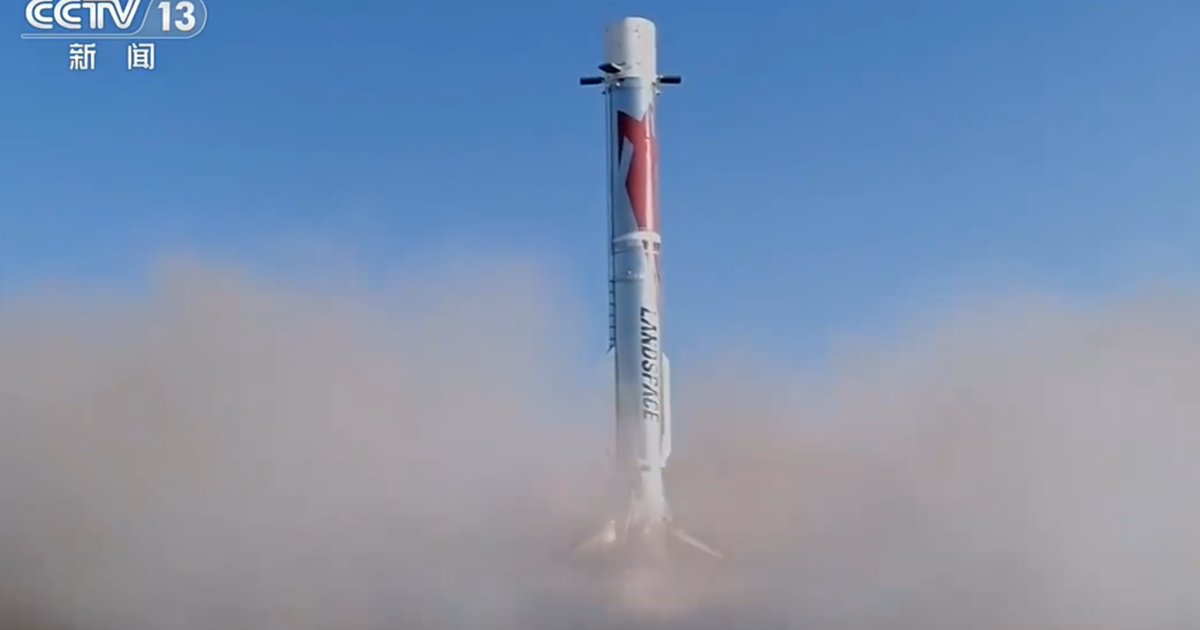
China achieved a historic milestone in space technology on Wednesday, August 19, 2026, as the Zhuque-3 reusable rocket developed by private company LandSpace successfully completed the nation's first land-based recovery of an orbital-class booster. The 66.1-meter rocket lifted off from the Dongfeng Commercial Space Innovation Pilot Zone near Jiuquan in northwestern China's Gansu province, with its first stage returning to land at a dedicated site in Minqin County, approximately 390 kilometers southeast of the launch pad .
Key Points
- The Zhuque-3 Y-2 rocket launched at 7:35 AM, carrying the Honghu-03 satellite to its designated orbit while the first stage executed a controlled vertical descent using deployable landing legs
- LandSpace, a private Chinese rocket firm, became only the third entity globally—after SpaceX and Blue Origin—to successfully land an orbital-class booster
- The 66.1-meter rocket features nine Tiansuo-12A liquid oxygen and methane engines, with the first stage comprising approximately 70 percent of total rocket cost
- China's achievement encompasses both sea-based net capture (demonstrated by the Long March 10B in July 2026) and land-based landing leg technology, making it the first nation to master both methods
- LandSpace is pursuing a listing on the Shanghai Stock Exchange's STAR Market, seeking to raise 7.5 billion yuan to support reusable launch service development
Why It Matters
This breakthrough positions China as a global leader in reusable rocket technology, potentially enabling significant cost reductions in space access since fuel constitutes only 1-3 percent of launch costs while the booster represents 70 percent of total rocket expense . For Hong Kong, advances in commercial space capabilities could create investment opportunities in aerospace-related ventures and strengthen regional positioning in the growing Asia-Pacific space economy.
This breakthrough positions China as a global leader in reusable rocket technology, potentially enabling significant cost reductions in space access since fuel constitutes only 1-3 percent of launch costs while the booster represents 70 percent of total rocket expense . For Hong Kong, advances in commercial space capabilities could create investment opportunities in aerospace-related ventures and strengthen regional positioning in the growing Asia-Pacific space economy.