Commentary: Holistic Approach Needed for SEN Education Beyond School Settings
HK01 · 1 SOURCES1 day ago3 MIN
Summary
An opinion piece published on October 19 argues that Hong Kong's approach to Special Educational Needs (SEN) education must move beyond school-centered interventions to embrace families and communities as essential partners in supporting affected children. Drawing inspiration from an October 13 episode of the TV program "Doctor, Do You Have an Illness?" featuring Dr. Wang Yuzhen, a California-licensed pediatrician specializing in ADHD who herself lives with the condition, the article emphasizes that the greatest barriers for SEN children often stem not from their conditions but from the labels and assumptions imposed upon them.
Key Points
- Dr. Wang Yuzhen, a California-licensed pediatrician specializing in ADHD who is herself a person with ADHD, appeared on the October 13 episode of "Doctor, Do You Have an Illness?" where filmmakers documented her daily life managing ADHD at her clinic and home .
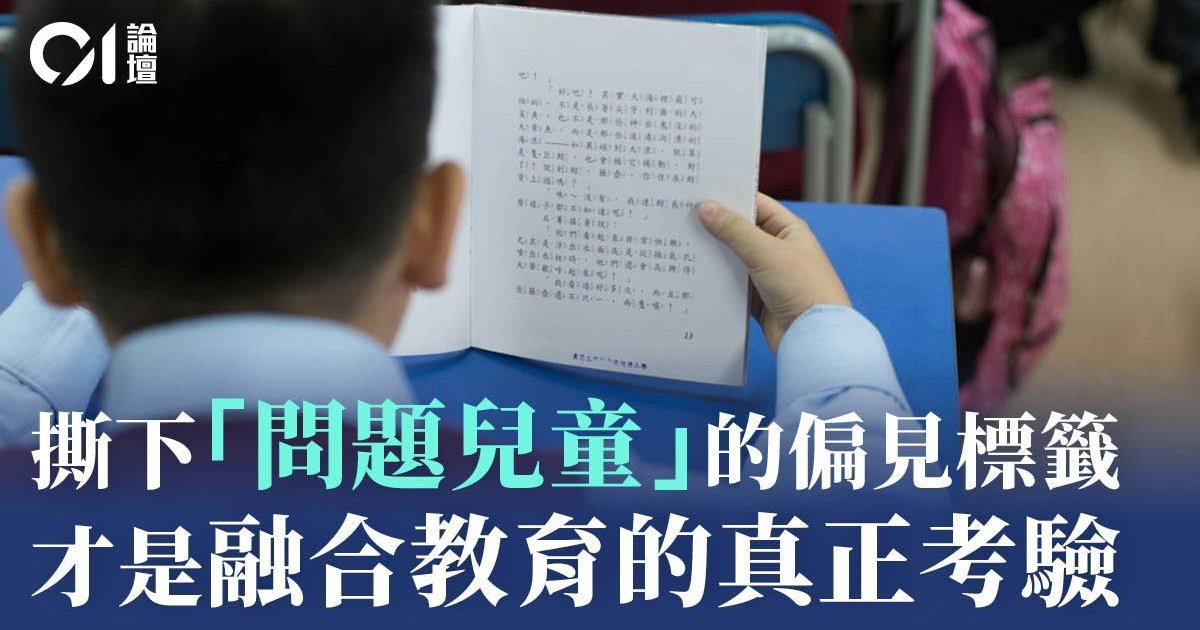
- Children with SEN are frequently labeled as lazy, careless, or unable to learn, when they actually require different pacing, alternative teaching methods, and supportive environments to succeed .
- Dr. Wang Yuzhen compares ADHD to nearsightedness, suggesting that medication functions like glasses—enabling access to the same content rather than providing unfair advantage .
- HKU Social Work and Social Administration Department Senior Lecturer Law Ming-fai supports this analogy, arguing that SEN accommodations like extra time or alternative formats represent fairness, not privilege .
- Parents of SEN children face substantial pressures including assessment appointments, school communications, therapy arrangements, homework conflicts, financial burdens, social isolation, and uncertainty about their child's future .
- The article advocates for family-based interventions including active listening, parent support groups, family counseling, and clear guidance on educational and medical procedures .
- Transitioning into adolescence amplifies family complexity as teens with SEN navigate desires for independence, changing peer relationships, and increased academic demands .
Why It Matters
The commentary arrives at a critical juncture for Hong Kong's education system, which has long grappled with implementing truly inclusive practices. By highlighting that children with learning difficulties in reading, writing, concentration, communication, or emotional regulation may still possess average or above-average abilities in other domains, the article challenges educators and policymakers to reconsider assessment frameworks that disproportionately judge students by conformity to standard classroom expectations . The call for a coordinated support ecosystem involving families, schools, professionals, and community resources reflects growing recognition that educational equity requires addressing underlying social and economic conditions that shape both child development and parental capacity to provide support.
The commentary arrives at a critical juncture for Hong Kong's education system, which has long grappled with implementing truly inclusive practices. By highlighting that children with learning difficulties in reading, writing, concentration, communication, or emotional regulation may still possess average or above-average abilities in other domains, the article challenges educators and policymakers to reconsider assessment frameworks that disproportionately judge students by conformity to standard classroom expectations . The call for a coordinated support ecosystem involving families, schools, professionals, and community resources reflects growing recognition that educational equity requires addressing underlying social and economic conditions that shape both child development and parental capacity to provide support.