PolyU Develops Quantum Tunneling Transistor to Overcome Chip Development Bottleneck
Bastillepost · 1 SOURCESabout 2 hours ago6 MIN
Summary
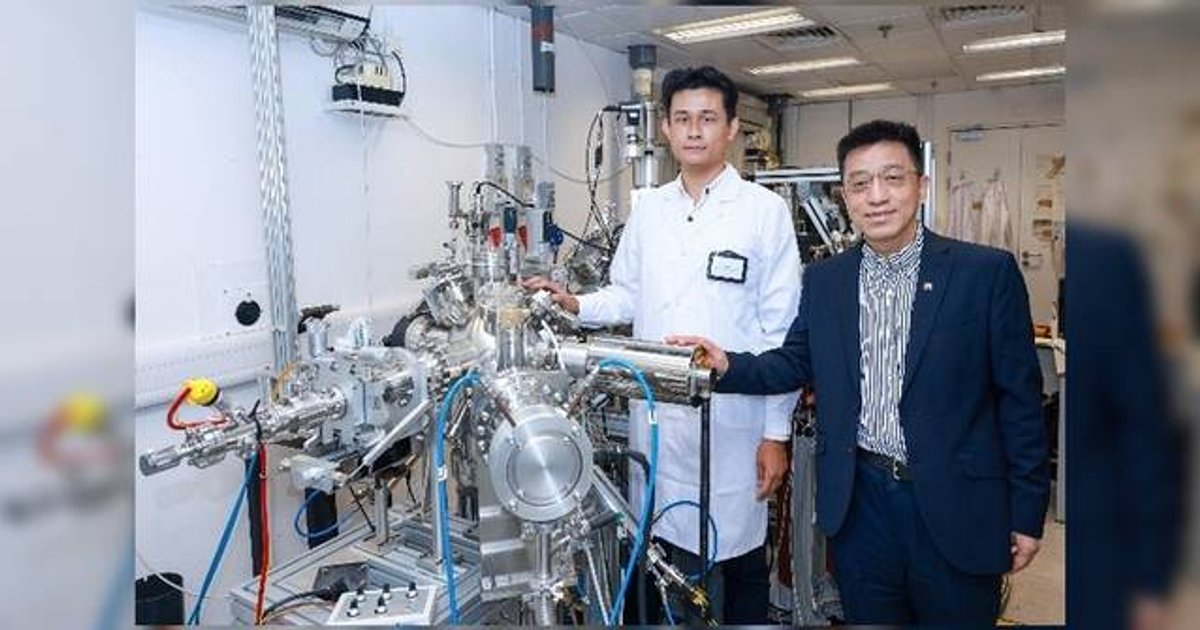
Hong Kong Polytechnic University researchers have achieved a major advancement in microelectronics by developing a quantum tunneling field-effect transistor that overcomes the Boltzmann limit constraining traditional semiconductor technology. Led by Professor Hao Jianhua, the team created a transistor using bismuth and indium selenide layers that achieves superior performance with far lower voltage requirements than conventional MOSFETs, potentially enabling the next generation of energy-efficient AI chips and advanced electronics.
Key Points
- PolyU's research team, led by Professor Hao Jianhua (郝建華) from the Department of Physics and Materials Science, collaborated with National University of Singapore, Hong Kong University of Science and Technology, Peking University, and Singapore University of Technology and Design to develop the new transistor .
- The transistor uses a two-dimensional heterostructure of bismuth (Bi) and indium selenide (InSe) created through pulsed laser deposition technology, achieving semiconductor properties from semi-metallic bismuth at nanoscale .
- The Bi/InSe quantum tunneling transistor achieves subthreshold swing far below the 60mV/decade thermal electron limit across six orders of magnitude of current switching range at room temperature .
- Operating on standard silicon substrates, the device requires only 160 millivolts gate voltage range compared to 800 millivolts needed by advanced MOSFETs, representing an 80% reduction in voltage requirements .
- The transistor delivers high output current of several microamperes per micrometer, enabling downstream logic gate driving and compatibility with existing integrated circuit chip manufacturing processes .
Why It Matters
This breakthrough addresses the International Roadmap for Devices and Systems' identification of TFETs as the most promising low-power replacement for traditional MOSFETs in future electronics. The compatibility with existing silicon-based manufacturing processes means this technology could enable scalable production of ultra-low-power microchips for AI hardware applications, positioning Hong Kong at the forefront of next-generation semiconductor development .
This breakthrough addresses the International Roadmap for Devices and Systems' identification of TFETs as the most promising low-power replacement for traditional MOSFETs in future electronics. The compatibility with existing silicon-based manufacturing processes means this technology could enable scalable production of ultra-low-power microchips for AI hardware applications, positioning Hong Kong at the forefront of next-generation semiconductor development .