Korean Stocks Sink 70% from Peak as $131 Billion Foreign Capital Exits
SingTao · 2 SOURCESabout 3 hours ago2 MIN
Summary
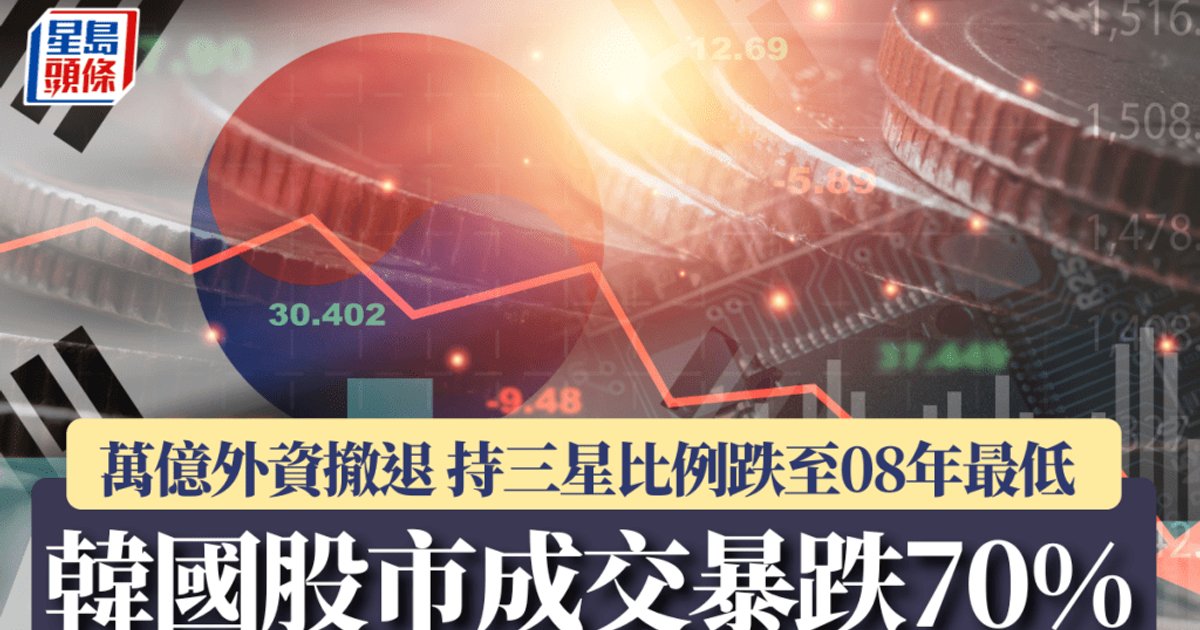
South Korea's equity market, which dominated global AI-related trading for much of this year, is now rapidly losing investor favor. Trading volumes on the Korea Stock Exchange (KOSPI) have collapsed 70% from their May peak, while foreign investors have pulled out a staggering $131 billion (approximately HK$1.02 trillion) — the highest withdrawal among major Asian markets. Samsung Electronics and SK Hynix, the two memory chip giants that have been the engine of Korea's market rally, are now facing unprecedented scrutiny from international funds.
Key Points
- Foreign investors have withdrawn $131 billion (HK$1.02 trillion) from Korean equities in 2026, the largest outflow among Asian markets
- KOSPI's trading volume has plummeted 70% from its late-May peak, while the index has fallen 22% in the second half of the year
- Foreign ownership of Samsung Electronics stands at 46.38%, the lowest level since January 11, 2008 (46.35%) during the global financial crisis
- SK Hynix and Samsung Electronics together account for more than half of the KOSPI's weighting, creating concentration risk
- The two chip giants are completing a combined 55 trillion won (US$41 billion) share buyback program, which accounted for the bulk of $23 billion in buy orders last month
- Foreign investors have net sold over 197 trillion won on the KOSPI this year, exceeding any previous annual record
- Samsung Electronics foreign ownership was at 52% at the start of 2026, dropping below 50% in March and to 46.37% by early October
Why It Matters
The exodus from Korean equities reflects a broader reassessment of where AI-related investment capital can generate the best returns, with Taiwan's more diversified technology ecosystem emerging as the preferred destination . As memory chip demand uncertainty grows and high-leverage-driven selling continues to shake confidence, Korea risks prolonged capital flight that could pressure its currency and delay economic recovery, with implications for Asian supply chains and Hong Kong investors with regional tech exposure.
The exodus from Korean equities reflects a broader reassessment of where AI-related investment capital can generate the best returns, with Taiwan's more diversified technology ecosystem emerging as the preferred destination . As memory chip demand uncertainty grows and high-leverage-driven selling continues to shake confidence, Korea risks prolonged capital flight that could pressure its currency and delay economic recovery, with implications for Asian supply chains and Hong Kong investors with regional tech exposure.