HK Police AI Engine Powers Interpol Cyber Operation, Urges Business Vulnerability Fixes
HK01 · 6 SOURCESabout 5 hours ago3 MIN
Summary
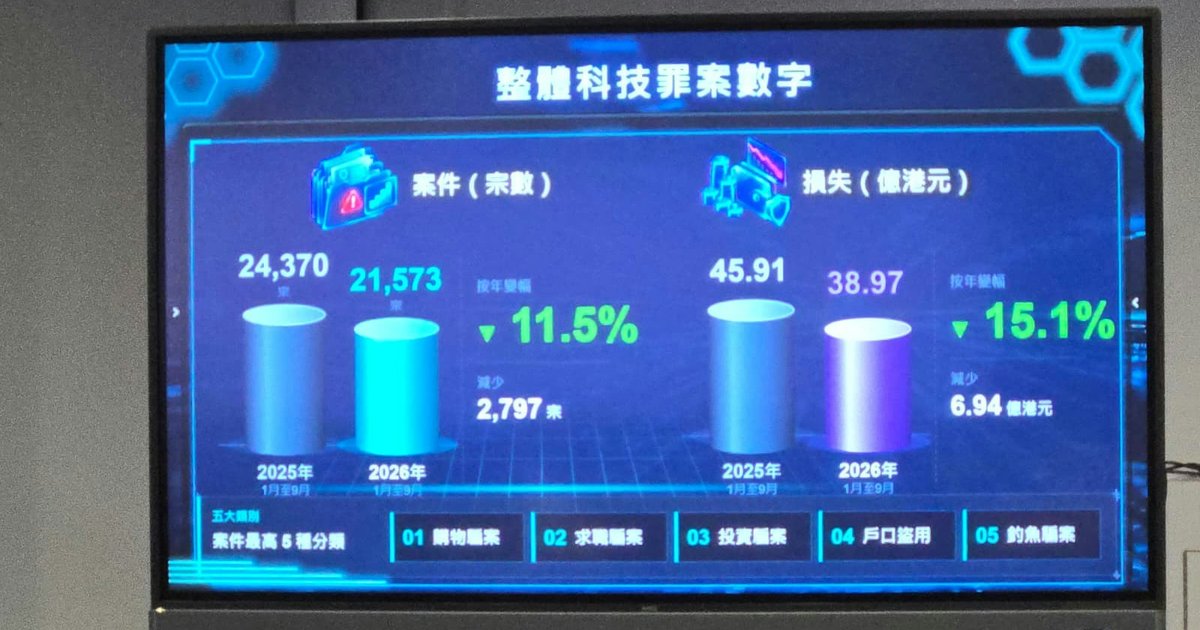
Hong Kong police have developed an AI analysis engine called Project RAPID that has become the technological backbone of Interpol's first AI-driven international cybercrime operation, successfully removing over 51,000 malicious websites and identifying approximately 1,700 victims across 47 jurisdictions. Data for January to September 2026 reveals overall technology crime cases fell 11.5 percent year-on-year to 21,573 cases, with losses decreasing 15.1 percent to HK$38.97 billion, though ransomware incidents rose 17.6 percent to 40 cases amid growing AI-assisted cyber attacks. Police are urging businesses to promptly patch system vulnerabilities as hackers increasingly deploy autonomous AI agents capable of round-the-clock network scanning and exploitation.
Key Points
- Hong Kong police developed Project RAPID, an AI analysis engine that served as the technological core of Interpol's first AI-driven international cybercrime operation
- Operation Rapidstrike (July 2025 to June 2026) investigated nearly 57,000 malicious domains, blocked over 51,000 phishing links, and shared intelligence with 47 jurisdictions
- January to September 2026: 21,573 tech crime cases (down 11.5%), HK$38.97 billion losses (down 15.1%), with 80 percent involving online scams
- Ransomware cases increased 17.6 percent year-on-year to 40 cases, while system intrusion cases fell to 29
- Police discovered over 44,000 high-risk vulnerabilities, with over 85 percent related to Remote Desktop Protocol (RDP) and PHP systems
- October 2026 saw multiple global cyberattacks dubbed "Black October," with police attributing the surge to proxy AI agents scanning and exploiting network vulnerabilities
- Operation Eagle dismantled fake Water Services Department phishing scams, arresting 16 suspects and removing over 1,200 suspicious websites
- Police identified 65 schools with outdated firewall firmware at risk of zombie network recruitment and provided on-site technical support
Why It Matters
The surge in AI-assisted cyberattacks—where autonomous agents continuously scan for vulnerabilities and execute breaches at machine speed—means no organization is safe from opportunistic targeting regardless of its perceived importance or value, fundamentally changing the threat landscape for Hong Kong businesses and individuals alike . Interpol's expansion of Operation Rapidstrike 2.0 to 24 jurisdictions demonstrates growing international consensus that proactive AI-driven detection and takedown of malicious infrastructure before victims are reached represents the future of cybercrime enforcement .
The surge in AI-assisted cyberattacks—where autonomous agents continuously scan for vulnerabilities and execute breaches at machine speed—means no organization is safe from opportunistic targeting regardless of its perceived importance or value, fundamentally changing the threat landscape for Hong Kong businesses and individuals alike . Interpol's expansion of Operation Rapidstrike 2.0 to 24 jurisdictions demonstrates growing international consensus that proactive AI-driven detection and takedown of malicious infrastructure before victims are reached represents the future of cybercrime enforcement .