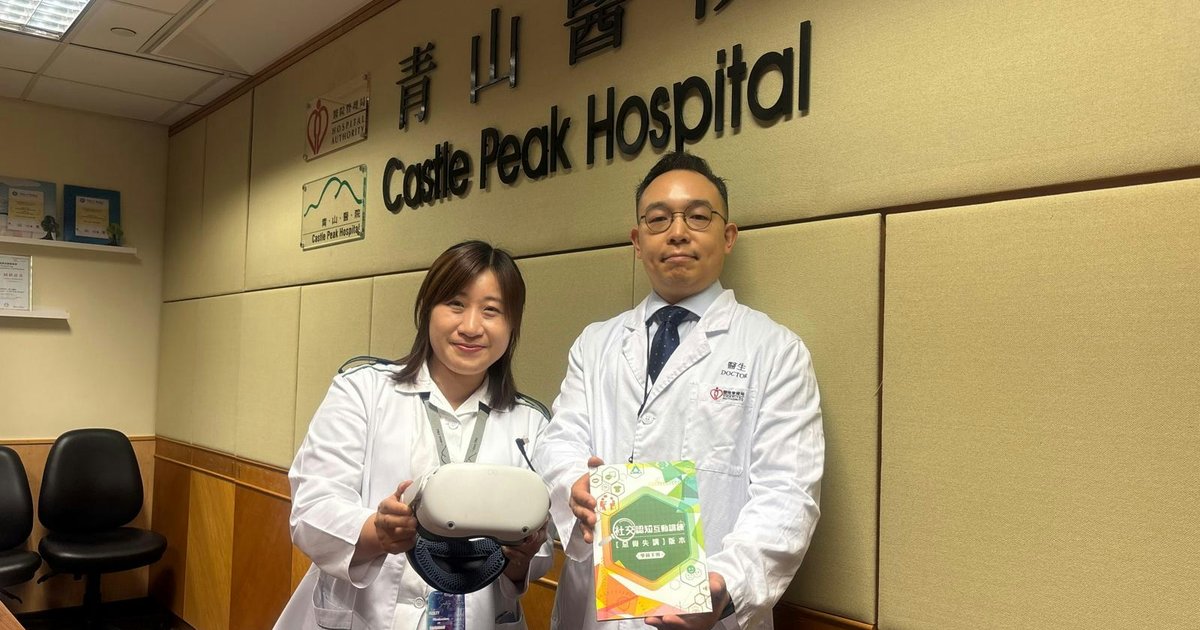
Castle Peak Hospital regularises VR social training
HK01 · 4 SOURCESabout 7 hours ago6 MIN
Summary
Castle Peak Hospital said it has regularised the use of virtual reality in social cognition training after a pilot run from July to October involving 13 adult schizophrenia patients showed improvement in emotion perception, theory of mind and attribution style. The VR component, formally introduced in July after earlier research and development work, adds immersive practice to a training model the hospital has offered since 2013. Hospital staff said the approach lets patients repeatedly rehearse everyday Hong Kong social situations in a realistic but safe setting, including workplace, school and friendship scenarios. A patient with bipolar disorder who joined the training said it helped him think more clearly, rely on evidence and avoid jumping to conclusions in social encounters.
Key Points
- Associate consultant doctor Lai Chun-lun (黎鎮麟) said psychiatric patients may have impaired “social information chips”, making it harder to read behaviour, relationships and unwritten social rules.
- The hospital’s social cognition framework focuses on three areas: emotion perception, theory of mind and attribution style, which medication alone improves only indirectly
- Since July, patients have used VR headsets to watch nine 360-degree locally produced scenarios and study seven emotions, including joy, sadness, anger, fear, shame, disgust and surprise.
- In the pilot, 13 adult schizophrenia patients trained in groups of four to five over eight one-hour sessions across one to two months, or from July to October.
- Hospital assessments found gains in all three domains, with average emotion-recognition scores rising from 14.08 to 15.83, while staff also reported stronger motivation and participation.
Why It Matters
For patients whose symptoms may be more stable but who still struggle with work, study and daily interaction, the programme offers a structured way to practise social judgement before facing real-world situations. Castle Peak Hospital is preparing a one- to two-year randomised controlled study and is also exploring expansion to more psychiatric groups, children and adolescents, as well as AI-generated training scenes if resources allow.