Legal debate centers on constitutional status of CCP leadership
HK01 · 1 SOURCESabout 2 hours ago2 MIN
Summary
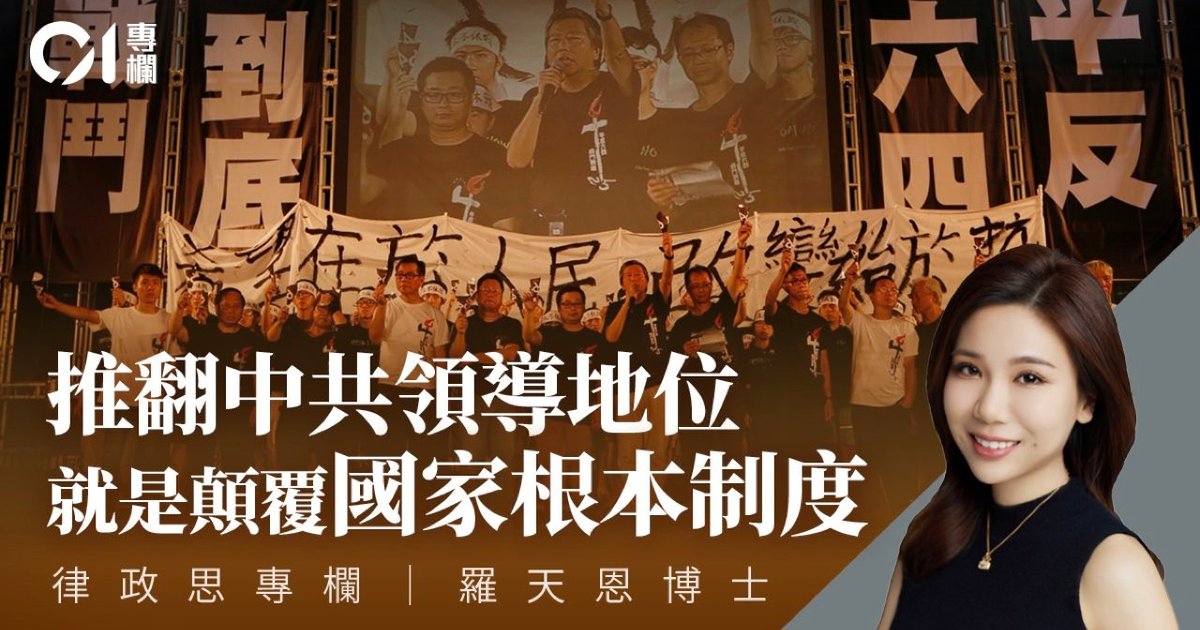
The commentary says a recent ruling in the Hong Kong Alliance case found that the group’s platform of ending one-party rule contravened China’s amended Constitution and supported convictions for inciting subversion of state power. It identifies the central legal issue as whether the leadership of the Chinese Communist Party forms part of the fundamental system of the state established by the Constitution for the purposes of Article 22 of the Hong Kong National Security Law. According to the court reasoning cited, because Article 1 of the Constitution now states that Communist Party leadership is the defining feature of socialism with Chinese characteristics, undermining that leadership is equivalent to undermining the constitutional fundamental system. The article further argues that, within the current constitutional order, there is no lawful route to terminate Communist Party leadership through constitutional amendment
Key Points
- Three judges said the Hong Kong Alliance’s call to “end one-party dictatorship” violated the 2018-amended Constitution, described as the parent law of the Basic Law
- The court linked Articles 22 and 23 of the Hong Kong National Security Law, holding that inciting others to attack Communist Party leadership can amount to inciting subversion
- The article traces constitutional development from the 1949 Common Program, through the 1954 Constitution, to the 1982 Constitution and the 2018 amendment
- It says the 2018 amendment inserted into Article 1 that Communist Party leadership is the most essential feature of socialism with Chinese characteristics
- Citing constitutional theory, the commentary argues amendment powers have implicit limits and cannot alter the state’s basic identity or abolish its socialist system
Why It Matters
For Hong Kong readers, the argument sets out a legal framework in which advocacy aimed at ending Communist Party leadership may be treated not as ordinary political expression but as a challenge to the constitutional order applied through the national security law. It also points to a narrower space for constitutional or political arguments that seek systemic change, because the commentary says such change is legally unavailable within the existing constitutional structure