German and American Scientists Win Nobel Medicine Prize for Brain Research
AM730 · 3 SOURCESabout 3 hours ago6 MIN
Summary
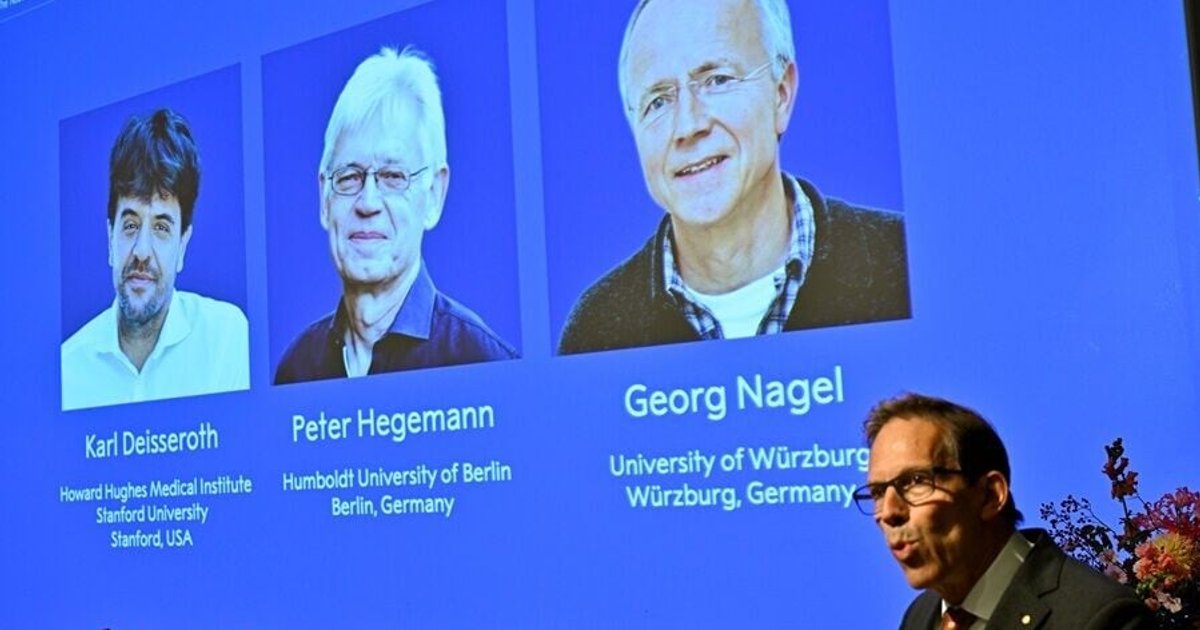
The 2026 Nobel Prize in Physiology or Medicine has been awarded to three scientists for their pioneering work in optogenetics, a revolutionary technique that uses light to control nerve cells in living brains. The prize was announced at the Karolinska Institute in Stockholm on Monday, October 5, marking the start of Nobel Week .
Key Points
- Karl Deisseroth (54), Peter Hegemann (71), and Georg Nagel (73) were honored for discovering light-gated ion channels and developing optogenetics
- Hegemann and Nagel identified channelrhodopsin in single-celled algae in the early 1990s; when exposed to blue light, ion channels open like a gate to generate electrical signals
- Deisseroth inserted the channelrhodopsin gene into rat nerve cells in 2005, successfully triggering neural signals through blue light illumination
- Two years after the 2005 publication, he demonstrated light-controlled nerve cell activity in living mouse brains, founding optogenetics
- The method is now used in laboratories worldwide to study how brain cells influence memory, sensation, and behavior
- Deisseroth works at Stanford University in California, Hegemann at Humboldt University of Berlin, and Nagel at the University of Wurzburg
- The prize of 12 million Swedish kronor (approximately 9.38 million HKD or 1.2 million USD) will be divided among the three winners
- Nobel Committee Secretary Thomas Perlman contacted all three winners by phone on Monday
- Anna Wedell, a genetics professor and committee member, stated this opens a new era in neuroscience and represents just the beginning
- Committee member Professor Pan Jiang (潘嬙) noted optogenetics shows significant clinical potential for treating neurological and psychiatric disorders
Why It Matters
Optogenetics provides researchers with an unprecedented tool to map brain circuits and understand how neural networks process information and generate behavior . Clinical applications are already being explored, including helping certain retinal disease patients recover partial vision and studying neural mechanisms behind depression, Alzheimer's disease, and chronic pain . For Hong Kong, this breakthrough offers new hope for patients suffering from neurological and psychiatric conditions, as research techniques developed by the laureates accelerate the development of targeted treatments for disorders affecting the brain and nervous system .
Optogenetics provides researchers with an unprecedented tool to map brain circuits and understand how neural networks process information and generate behavior . Clinical applications are already being explored, including helping certain retinal disease patients recover partial vision and studying neural mechanisms behind depression, Alzheimer's disease, and chronic pain . For Hong Kong, this breakthrough offers new hope for patients suffering from neurological and psychiatric conditions, as research techniques developed by the laureates accelerate the development of targeted treatments for disorders affecting the brain and nervous system .