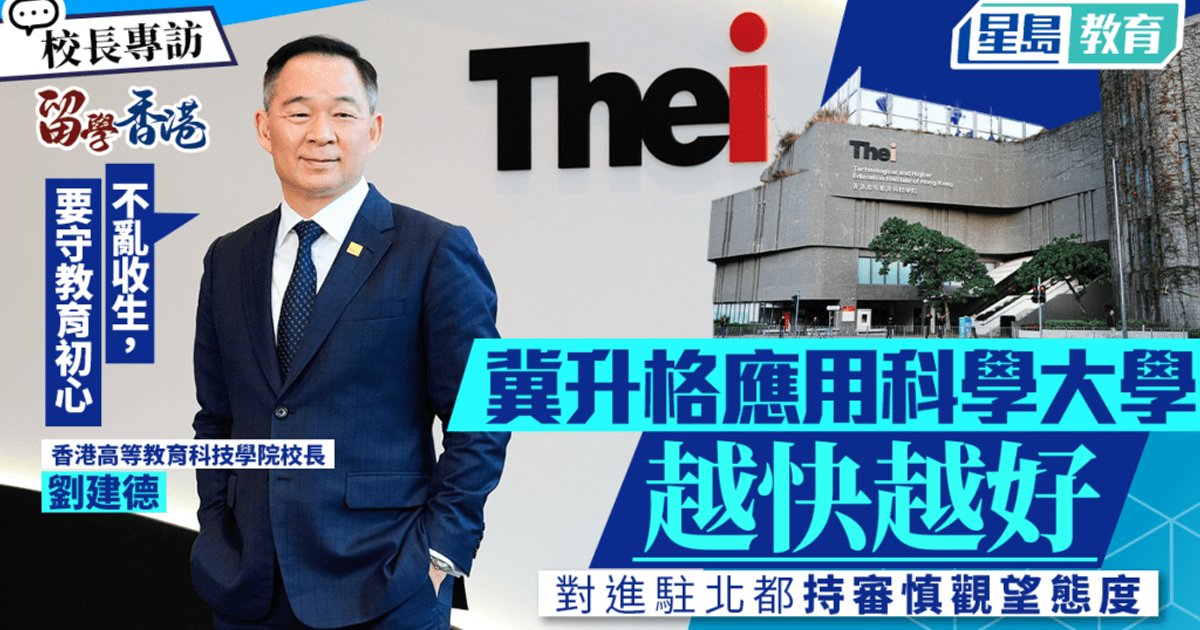
THEi seeks fast upgrade, cautious on Northern Metropolis
SingTao · 1 SOURCESabout 7 hours ago8 MIN
Summary
THEi president Lau Kin-tak (劉建德) said the self-financing institution is moving through the formal process to upgrade into a university of applied sciences and hopes approval can come as quickly as possible. He said the school would keep its applied, industry-linked mission after any upgrade and is not preparing to move into the first phase of the Northern Metropolis university town.
Key Points
- Lau said THEi has already passed reviews in three programme areas and met the requirement of at least 1,500 degree students for two consecutive years.
- He said the institute is now handling registration under the Post Secondary Colleges Ordinance, Chapter 320, and related follow-up applications, without speculating on a timetable.
- THEi currently offers more than 20 applied-science-based bachelor’s and master’s programmes across seven academic areas, from design and engineering to Chinese medicine, food science and hospitality technology.
- Lau said THEi will not follow the path of a traditional university after any upgrade, arguing Hong Kong does not need more institutions focused mainly on rankings and citation counts.
- On the Northern Metropolis, he said THEi was not ready for the first stage and would only consider entry later if nearby industry support matched its disciplines.
- THEi’s model centres on close collaboration with employers, including mandatory internships of three to six months and capstone projects completed with companies. Lau said the school deliberately avoids launching programmes that are fashionable now but may face labour oversupply by the time students graduate, because approval and study together can take about five and a half years.
- He cited the government’s gradual phase-out of fuel vehicles as a reason for opening a Bachelor of Engineering (Honours) in Electric Vehicle Design and Technology in September, saying the programme was co-designed with industry and supported by donated professional tools and equipment.
- Lau also said THEi keeps a tight cap on student intake despite the financial pressure on self-financing institutions, because he does not want to expand enrolment if graduates cannot all find suitable jobs. He said some students receive multiple job offers before graduation, while applied research projects such as the POWERMAN mobile charging robot and a Chinese medicine team’s gout treatment work using Smilax glabra show the school’s emphasis on practical outcomes.
- On the Northern Metropolis, Lau said campus expansion cannot be judged by buildings alone. He argued that if surrounding technology parks or companies are unrelated to THEi’s subjects, or if relevant industrial zones are still half an hour away, staying at the Chai Wan campus could make more sense. He added that, for a self-financing institution, any investment of tens of billions of dollars must be weighed carefully.
Why It Matters
THEi’s upgrade bid and its insistence on staying application-led could shape how Hong Kong defines the role of universities of applied sciences, especially as policymakers push for stronger links between education and industry. Its caution over the Northern Metropolis also underlines that new campuses alone may not attract institutions unless transport, industry clustering and financial viability are aligned.