Former Observatory Chiefs Urge Labour Dept to Adopt Scientific Heat Standard for Outdoor Workers
Crhk · 2 SOURCESabout 2 hours ago5 MIN
Summary
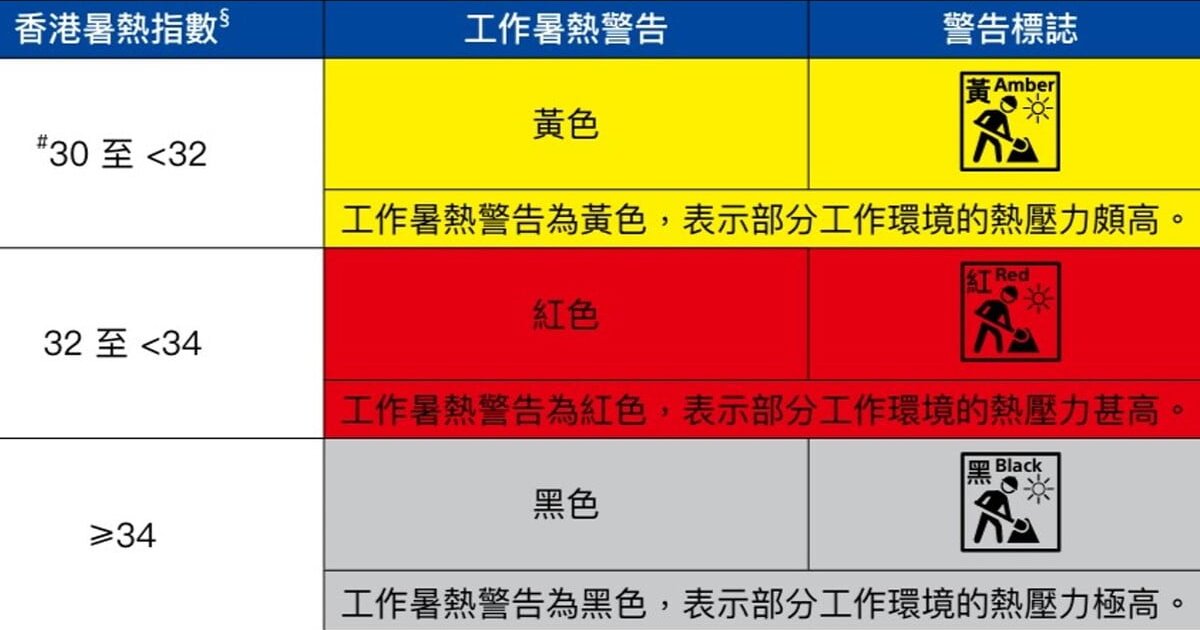
Two former Hong Kong Observatory directors have publicly urged the Labour Department to adopt Wet Bulb Globe Temperature as the scientific basis for work heat warnings, arguing that the current use of the Observatory's Heat Index is fundamentally flawed. Lee Chun-wing (who served as director from 2009 to 2011) and Shum Chi-ming (who succeeded him from 2011 to 2020) co-authored an article in Ming Pao titled "工作暑熱警告的困境及改善建議" (Challenges and Improvement Suggestions for Work Heat Warnings). They contend that the Heat Index was designed for the general public, most of whom remain in air-conditioned indoor spaces during hot weather, while work heat warnings target outdoor labourers such as construction workers and cleaners who face direct sun exposure .
Key Points
- Lee Chun-wing (2009–2011) and Shum Chi-ming (2011–2020) co-authored an article calling for the Labour Department to adopt Wet Bulb Globe Temperature data for work heat warnings
- The Observatory's Heat Index formula is 0.80×Dry Bulb Temperature + 0.05×Black Globe Temperature + 0.15×Air Temperature, designed for indoor populations with air conditioning
- Work heat warnings are intended for outdoor workers including construction site labourers and street cleaners who face direct solar radiation and heat stress
- Labour Department Director Hui Chak-sum acknowledged on July 11 that the current heat stress model underweights solar radiation for workers under direct sunlight
- Even when record-breaking temperatures occurred on Sunday, only a yellow work heat warning was issued, prompting criticism that the warning was ineffective
Why It Matters
This debate highlights a critical gap between scientific measurement tools and their practical application in protecting Hong Kong's outdoor workforce. With extreme heat events becoming more frequent and intense due to climate change, the Labour Department faces mounting pressure to implement evidence-based changes that could prevent heat-related illnesses and deaths among vulnerable workers .
This debate highlights a critical gap between scientific measurement tools and their practical application in protecting Hong Kong's outdoor workforce. With extreme heat events becoming more frequent and intense due to climate change, the Labour Department faces mounting pressure to implement evidence-based changes that could prevent heat-related illnesses and deaths among vulnerable workers .