Taxi Fails to Stop, Causes 3-Vehicle Rear-End Collision on Lantau Link
SingTao · 1 SOURCES1 day ago4 MIN
Summary
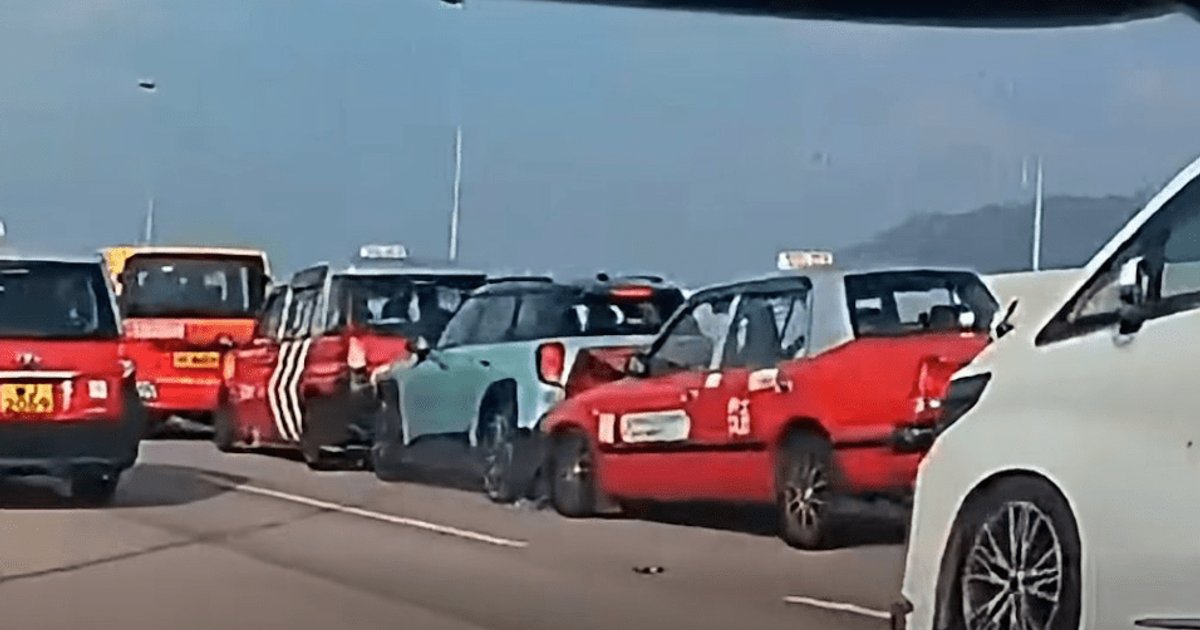
A three-vehicle rear-end collision, commonly known locally as a "stacked collision" (串燒), took place on the Lantau Link's North Lantau Highway on Wednesday morning (October 15). A taxi failed to brake in time for queued traffic, crashing into a stationary private car with such force that its hood was crumpled and front bumper destroyed. A white private car behind managed to swerve into the middle lane to narrowly escape the collision. Police responded to the scene and confirmed no injuries resulted from the incident.
Key Points
- The collision occurred on the Lantau Link's fast lane heading toward North Lantau Island at approximately 8:00 a.m. on October 15 .
- A private car ahead had stopped due to traffic congestion when the taxi approached and failed to slow down, striking the rear of the stationary vehicle .
- The impact was so severe that the taxi's hood buckled upward and its front bumper and components were visibly damaged .
- The white private car behind immediately applied its brakes and steered into the middle lane, narrowly avoiding the wrecked vehicles .
- Police officers arrived at the scene, conducted checks, and confirmed that no one was injured in the incident .
Why It Matters
The incident has reignited online debates about safe driving practices on Hong Kong's expressways, with netizens questioning whether drivers maintain adequate following distances. The saying "The biggest test on the fast lane isn't your brakes—it's the driver behind you" has resonated widely, underscoring how a single moment of inattention can create chain-reaction hazards on high-speed corridors .
The incident has reignited online debates about safe driving practices on Hong Kong's expressways, with netizens questioning whether drivers maintain adequate following distances. The saying "The biggest test on the fast lane isn't your brakes—it's the driver behind you" has resonated widely, underscoring how a single moment of inattention can create chain-reaction hazards on high-speed corridors .