SpaceX Dragon Delivers Four Astronauts to ISS on 13th Crewed Mission
Thestandard · 2 SOURCESabout 3 hours ago2 MIN
Summary
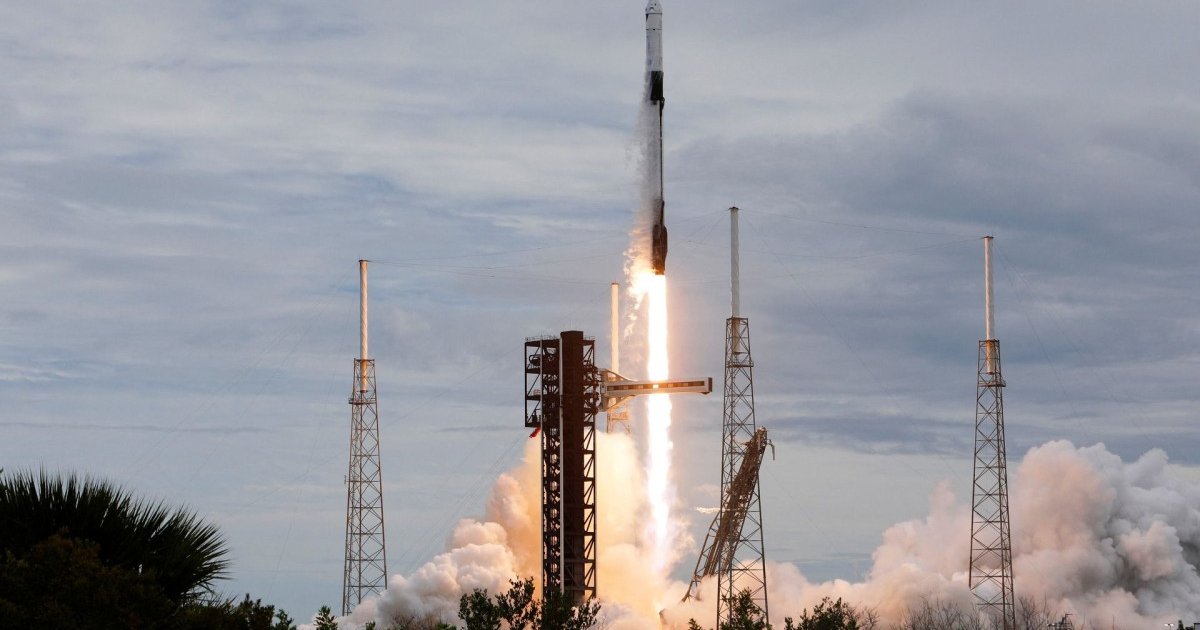
SpaceX launched its 13th long-duration astronaut crew to the International Space Station on Thursday, 1 October 2026, from Cape Canaveral Space Force Station along Florida's Atlantic Coast. The Falcon 9 rocket carried a Crew Dragon capsule with four crew members: NASA astronauts Jessica Watkins and Luke Delaney, Canadian astronaut Joshua Kutryk, and Russian cosmonaut Sergey Tetetyatnikov. The capsule separated successfully and began an eight-hour journey to dock with the ISS approximately 400 kilometres above Earth, with docking expected around 7 p.m. EDT. The mission marks a significant milestone in commercial spaceflight, coming just days after SpaceX's Starship spacecraft completed its first commercial satellite deployment on its 14th uncrewed test flight .
Key Points
- The Falcon 9's reusable first-stage booster separated within three minutes of launch and successfully returned to Earth for a landing at Cape Canaveral .
- Mission commander Jessica Watkins, a 38-year-old geologist-turned-astronaut, is making her second voyage to space and becomes the first NASA astronaut to fly twice aboard a Crew Dragon .
- The international crew will spend six months aboard the ISS conducting scientific experiments focused on human health and performance during long-duration spaceflight .
- This mission represents the 13th long-duration space station team that NASA has flown aboard SpaceX vehicles since the programme began sending US astronauts to orbit in May 2020 .
- The launch follows SpaceX's recent Starship milestone, with that next-generation spacecraft completing its first commercial satellite deployment on its 14th uncrewed test flight .
Why It Matters
This launch demonstrates the growing maturity of commercial spaceflight capabilities, with SpaceX now reliably transporting international crews to the ISS as a cornerstone of human spaceflight operations. The scientific research conducted during this six-month mission will provide crucial data for understanding human adaptation to microgravity, directly informing NASA's Artemis programme and eventual crewed missions to Mars .
This launch demonstrates the growing maturity of commercial spaceflight capabilities, with SpaceX now reliably transporting international crews to the ISS as a cornerstone of human spaceflight operations. The scientific research conducted during this six-month mission will provide crucial data for understanding human adaptation to microgravity, directly informing NASA's Artemis programme and eventual crewed missions to Mars .